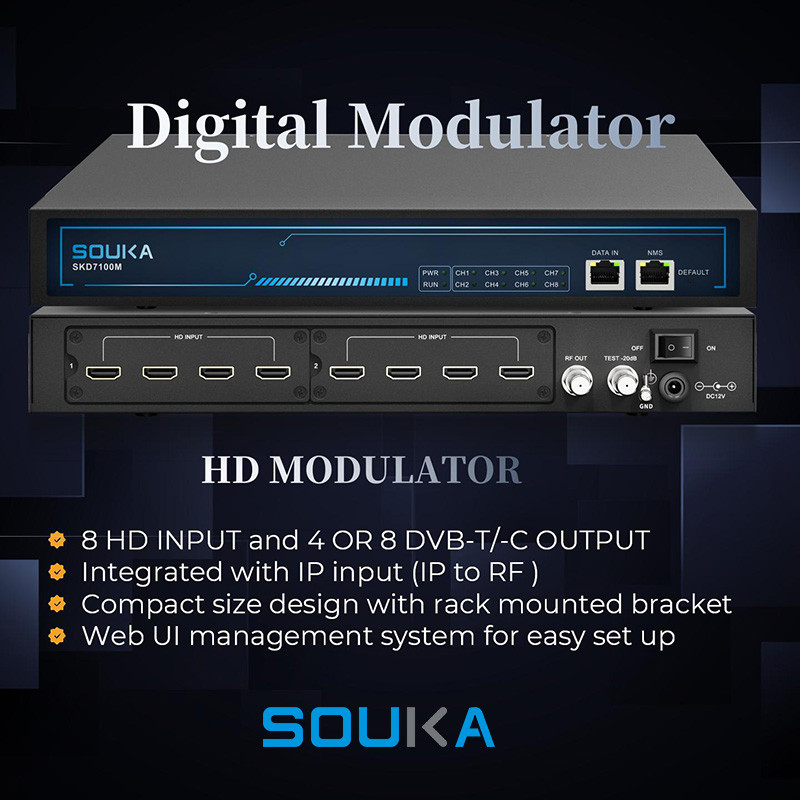
Choosing an HD modulator for a hotel starts with the televisions and the existing coax network, not the number of connectors on a product photograph. A unit that accepts your source may still use an RF standard, video codec, or channel configuration that guest-room TVs cannot decode. This guide helps hotel engineers, system integrators, and B2B buyers turn those compatibility checks into a practical equipment specification.
The aim is a predictable channel lineup across the property, with documented test results and a manageable maintenance plan. Use the selection sequence below before comparing quotations, and confirm the final configuration against the exact equipment and television models in your project.
What an HD modulator does in a hotel headend
An HD modulator prepares a television service for distribution as a radio-frequency signal over coaxial cable. Many HDMI models combine an encoder, a transport-stream multiplexer, and an RF modulator in one chassis. Other equipment accepts an already encoded IP transport stream. These are different input architectures, even when the devices ultimately feed the same coax network.
A typical signal path is source equipment, encoder or input gateway, digital modulation, RF combining and distribution, then the television tuner. The TV selects a service from the resulting channel lineup. A conventional one-way RF system does not by itself provide personalized menus, room-specific messaging, or video on demand; those functions require additional system capabilities.
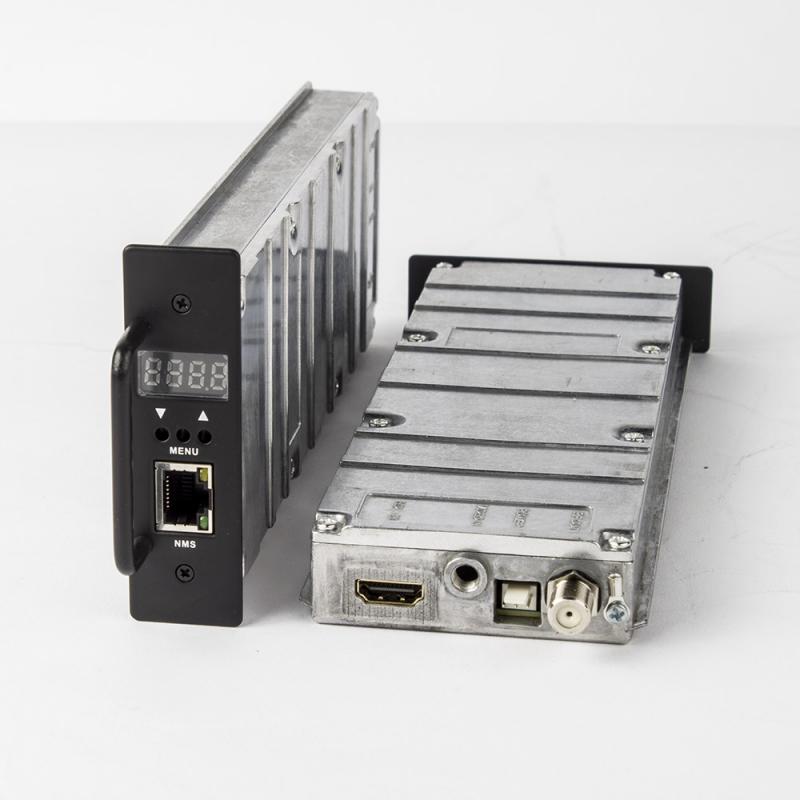
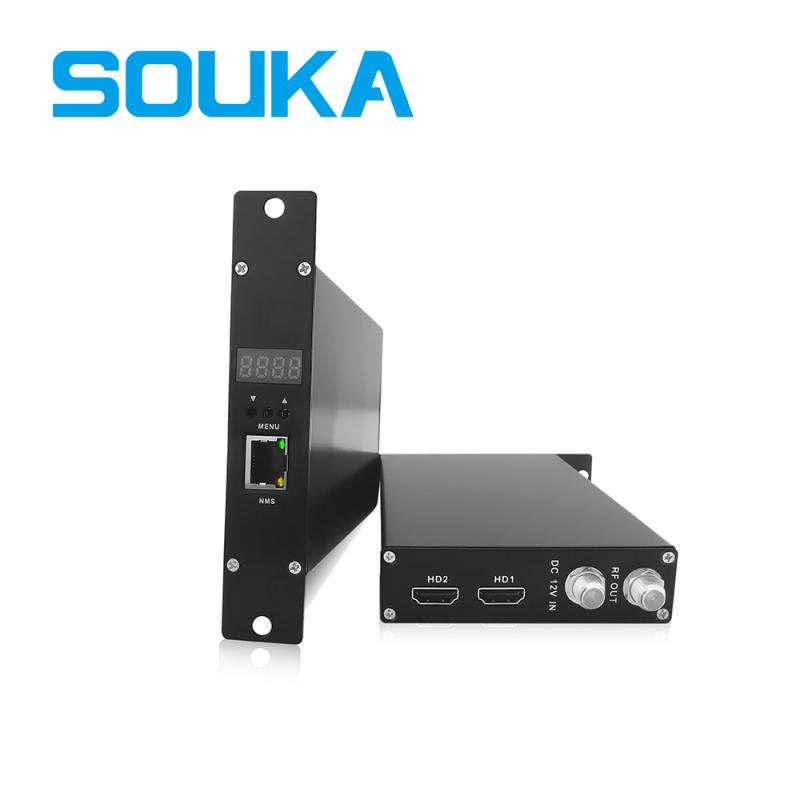
For equipment families and a starting point for a project shortlist, review SOUKA's cable TV modulators. Keep the overall architecture separate from an individual device purchase: source receivers, power supplies, combining losses, amplifiers, and room outlets all influence the delivered result.
Before replacing a working headend, record the existing channel names, source paths, RF frequencies, and television scan settings. This simple baseline helps distinguish a new equipment fault from a pre-existing distribution issue and gives the installation team a practical rollback reference.
Start with a television and source compatibility matrix
The most useful procurement document is often a spreadsheet listing every TV model in the building. Record the installed quantity, supported digital tuner standards, video and audio decoding support, channel-scan mode, and any hotel-mode restrictions. Test a representative television from each group rather than relying on the screen's HD or 4K marketing label.
Match the complete receiving chain
HDMI modulator compatibility involves more than HDMI input resolution. The RF standard must match the tuner, while the encoded video and audio must match the television decoder. A TV can detect an RF multiplex yet show no picture or produce no sound if one of these layers is unsupported. Country settings and firmware may also change which tuning modes are available.
List the source equipment just as carefully: receiver model, output resolution, frame rate, audio format, connector, and restart behavior. Confirm content-provider authorization and applicable distribution rights before integrating paid programming. Protected HDMI sources may not be usable with a given encoder; do not assume a purchase will remove content-protection restrictions.
Ask the supplier to demonstrate the actual source-to-TV combination. Include channel changing, loss and restoration of the source, and power cycling. An approval sample tested with the hotel's oldest television is more informative than a demonstration using only a new laboratory display.
Choose the RF standard before comparing features
The destination market gives an initial clue, but the installed tuner determines the final choice. Do not treat DVB-T, DVB-T2, DVB-C, ATSC, and ISDB-T as interchangeable output options. Even where one unit offers multiple standards, the quotation should identify the supplied hardware, firmware, licensing, and configuration.
| Output family | Primary selection check | Procurement question |
|---|---|---|
| DVB-T / DVB-T2 | Exact terrestrial standard supported by the television | Which standard, bandwidth, codec, and scan settings were tested? |
| DVB-C / cable QAM | Cable tuner compatibility and the relevant QAM specification | Which cable standard or annex and symbol-rate settings are supported? |
| ATSC 1.0 | ATSC 1.0 receiving capability and compatible service encoding | Does the tested output work with the installed tuner and channel map? |
| ISDB-T | Regional implementation and receiver compatibility | Has the exact regional TV model passed picture and audio testing? |
The ATSC A/53 standard defines ATSC digital television system components including its VSB transmission subsystem. DVB publishes separate specifications for terrestrial and cable systems in its official standards catalogue. These references explain why a generic claim of digital-TV compatibility is insufficient.
For a focused discussion of the terrestrial standards, see our DVB-T versus DVB-T2 comparison. Request the project's supported configuration in writing before ordering; optional output modes should never be treated as automatically included.
Separate input count, TV services, and RF carriers
Channel count is ambiguous in quotations. It may describe physical inputs, encoded services, RF output carriers, or the programs visible on the television. Specify each quantity separately. Four source inputs do not automatically mean four RF carriers, and a chassis with many input positions may require additional modules or licenses.
Use an explicit capacity worksheet
For illustration, suppose a hotel needs twelve independently selectable programs. If each is budgeted at 6 Mb/s video plus 0.2 Mb/s audio, the program payload totals 74.4 Mb/s before service information and other transport requirements. This is a planning example, not a recommended encoding preset. Actual requirements vary with picture complexity, codec, quality target, and multiplex configuration.
Compare that workload with the usable capacity of the proposed output configuration. The number of required RF carriers depends on that capacity and operational headroom; it cannot be inferred from the number of rooms. Many televisions can receive the same broadcast services without requiring a separate encoder for each room.
Account for future channels, source changes, and redundancy in a separate expansion line. Review the relevant digital modulator options with this worksheet, and ask the supplier to identify any limits shared across the chassis, such as total encoding throughput or the maximum number of output multiplexes.
Check picture quality, audio, latency, and channel information
A resolution figure alone does not establish picture quality. Check the supported input frame rates, output resolution, video codec, bitrate controls, and handling of interlaced material. Use challenging footage such as sports, moving text, and dark scenes when comparing a proposed configuration. A static test picture can hide compression problems.
Audio deserves its own acceptance test. Verify the chosen codec, channel layout, lip synchronization, and volume consistency between sources. Where multiple TV generations coexist, prefer a configuration demonstrated across the installed fleet. A technically newer codec is not helpful if many rooms require replacement televisions to decode it.
Test the guest-facing behavior
Ask how service names, logical channel numbers, language labels, and guide information are configured and retained. Confirm that the room TVs place channels in the intended order after a scan and after power is restored. Not every combination of receiver and signalling handles channel numbering in the same way.
Measure end-to-end delay when televisions share an area with a direct source display or live sound. Encoder settings, buffering, decoding, and the television itself can contribute to delay. Require a test under the intended settings instead of accepting an unexplained low-latency claim. Record the settings that passed so later maintenance does not accidentally change the guest experience.
Survey the coax network and build an RF channel plan
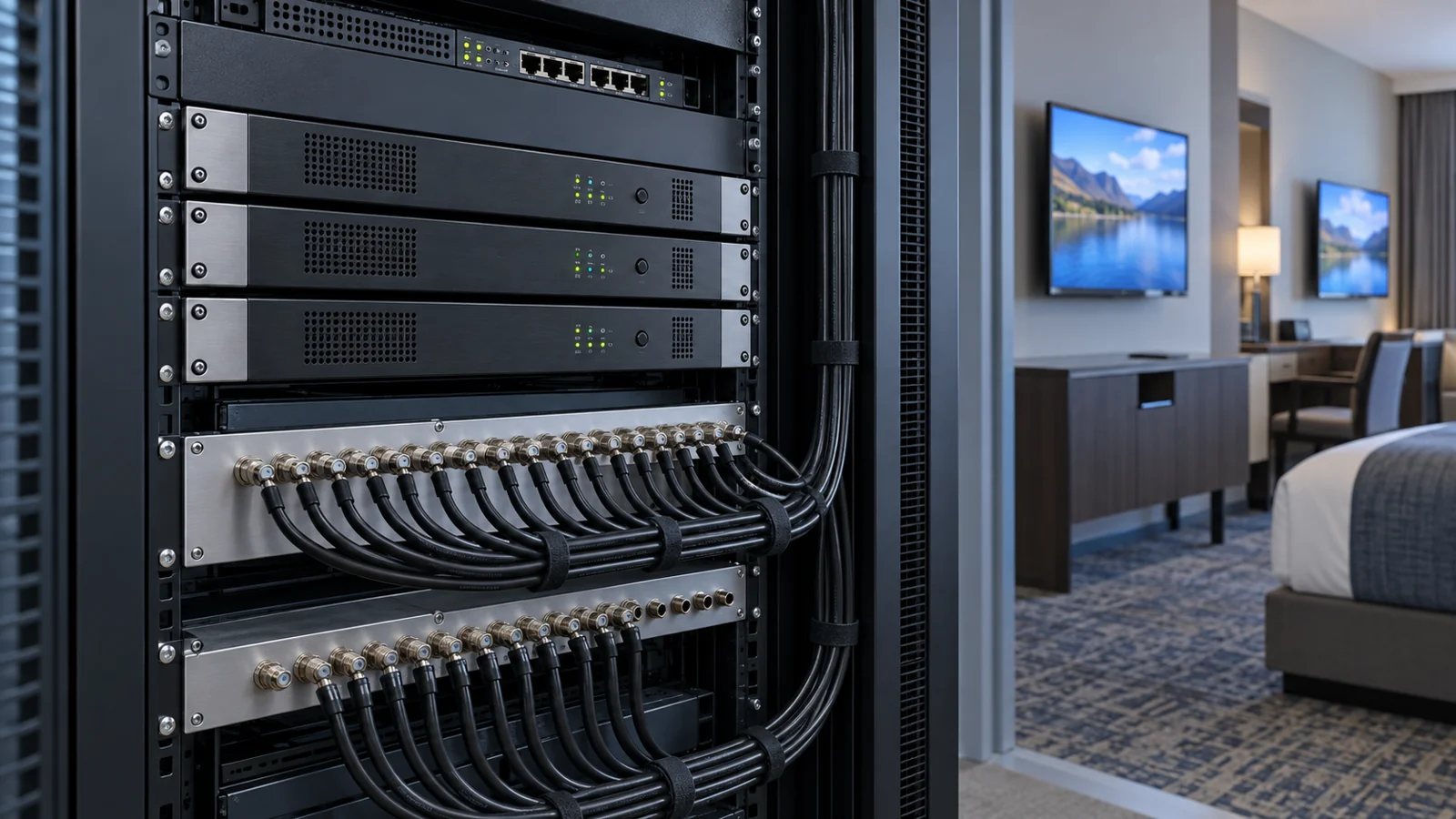
An RF modulator for TV cannot repair a damaged distribution network. Inspect cable condition, connector quality, shielding, splitters, directional taps, amplifiers, and any optical links. Record the frequency range of each component. A network that carried an older channel lineup may not pass the new frequencies with the same performance.
Prepare a frequency plan covering existing and proposed carriers. Check for collisions, the bandwidth occupied by each carrier, and the effect of combining multiple outputs. An RF combiner introduces loss, while amplifier loading changes as more carriers are added. Raising output power without checking the whole chain can overload a downstream device or a nearby TV input.
Measure at the endpoints
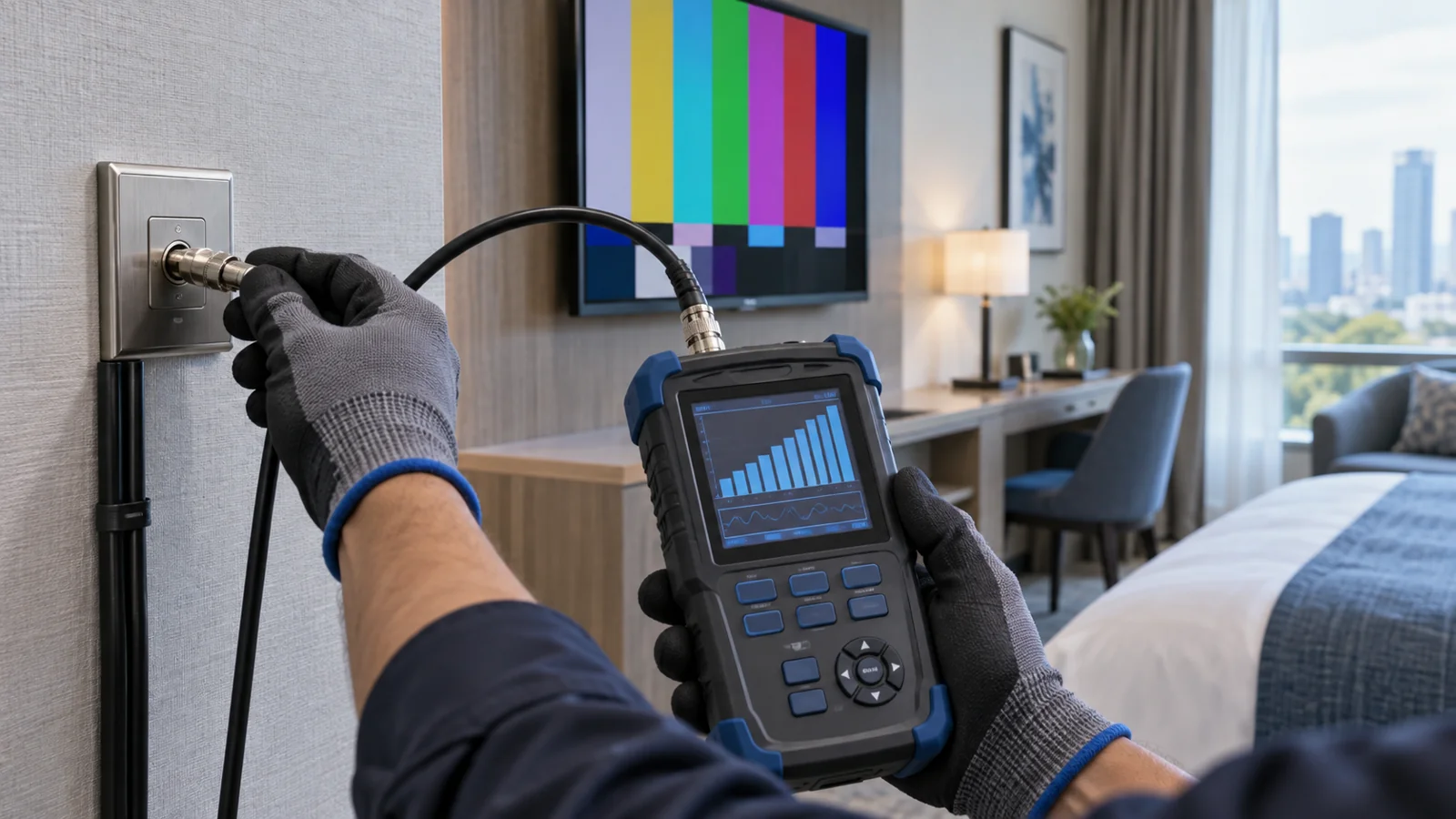
Use an appropriate RF meter to assess level and signal quality at the headend, intermediate points, and representative room outlets. Include the shortest and longest paths and the highest-loss branches. Evaluate modulation error ratio and error measurements where supported by the chosen standard and meter. Set acceptance limits from the equipment specifications and engineered network design, not a universal internet checklist.
Label the tested outlets and keep the measurements with the channel plan. If a room fails, compare its result with nearby points to locate the problem. A repeatable measurement record is much more useful than a handover note saying that the picture looked clear on one television.
Decide whether coax RF, IPTV, or a hybrid fits the hotel
A hotel cable TV system can be a practical choice when the property has serviceable coax wiring and primarily needs a consistent live-channel lineup. Reusing that infrastructure may simplify a refurbishment, provided the survey confirms it is suitable. The saving must be evaluated against repairs, receiver compatibility, and the required guest functions.
IPTV may be more appropriate where the brief includes interactive menus, centralized guest interfaces, or integration with other hotel systems. Those functions still depend on the selected middleware, endpoints, network design, and agreed integrations. They should be specified and tested rather than assumed from the term IPTV.
A hybrid design can retain RF distribution for live television while using a separate IP layer for other functions. It can also introduce additional support responsibilities. Identify which team owns each failure scenario and how content, channel numbering, and endpoint configuration remain consistent during staged upgrades.
Compare the alternatives in our hotel IPTV versus cable TV guide, then examine the Cable TV Solution for Hotels against your survey and service requirements. The decision should follow the hotel's operating brief rather than a preference for one technology label.
Plan commissioning before issuing the purchase order
Commissioning criteria belong in the request for quotation. Agree what the supplier will test, what the installer will measure, and what the hotel must provide. Make the representative TV models, source devices, test material, target channel lineup, and acceptance record part of the plan before equipment ships.
- Bench test: connect the exact source, modulator configuration, and representative TVs. Confirm picture, audio, service names, channel order, and source recovery.
- Distribution test: install the planned combining and amplification chain. Check outlet performance across the surveyed branches with all planned carriers active.
- Operational test: exercise power recovery, configuration restoration, channel changes, and management access. Run an agreed stability test appropriate to the project.
- Handover: provide the final channel plan, configuration backup, measured results, firmware versions, and a clear support contact.
Record problems as reproducible conditions: affected source, TV model, outlet, time, settings, and symptoms. This makes it easier to separate source interruptions, encoding faults, tuner incompatibility, and distribution losses. A vague report that the system freezes is difficult for any supplier to diagnose remotely.
Agree the maintenance window for changing channel settings and keep a known-good configuration. Test a replacement unit or module before an urgent outage makes it necessary. If redundancy is required, specify the failure it must cover; a spare encoder does not protect against every upstream source or building power failure.
Protect the rollout and maintenance window
Commission a small representative area before moving the whole property. Choose rooms on different distribution branches and include every television generation. Agree a maintenance window with hotel operations, retain the previous configuration, and identify who can authorize rollback. Avoid changing source settings, RF frequencies, and amplifier levels simultaneously without recording each step.
During the pilot, ask staff to repeat normal guest actions: power the TV off overnight, switch through the entire lineup, adjust volume, and return to television mode after using another input. Recheck the network after all planned carriers are active. A successful single-channel test does not establish that the fully loaded headend will behave identically.
At handover, assign ownership of configuration backups, administrator access, spare equipment, and the support contact list. Record firmware versions and a change history so a future technician can restore the approved settings. Ask for the replacement procedure if a module fails, including whether channel identities or tuning instructions will change. These operational details help procurement compare the lifetime support burden rather than only the initial hardware quotation.
Send suppliers a complete procurement brief
A useful quotation request describes the system boundary and the evidence needed for approval. Send the destination country, television model list, source interfaces, required program count, preferred RF standard, and a summary of the coax survey. Include the intended expansion and any rack-space, power, cooling, or management constraints.
- Ask which input modules, output modes, licenses, and accessories are included in the quoted configuration.
- Request supported video and audio formats and a written result for the proposed TV compatibility test.
- Define channel-management access, configuration backup, firmware support, warranty terms, and replacement arrangements.
- For OEM or distributor projects, separately agree branding, packaging, documentation, sample approval, and repeat-order configuration control.
- Compare the installed scope: equipment, combining, network repairs, commissioning, training, and spares.
SOUKA's range includes multiple headend and encoder-modulator configurations. The relevant question is which combination fits your sources, televisions, and distribution design. Request a project-specific assessment instead of assuming that the highest input count or broadest feature list is the best purchase.
For a refurbishment, add permitted room-access times and a staged cutover plan. For a new property, request a mock-up room test before ordering the full television fleet. Both steps help uncover incompatible assumptions while they are still inexpensive to change.
Related Products
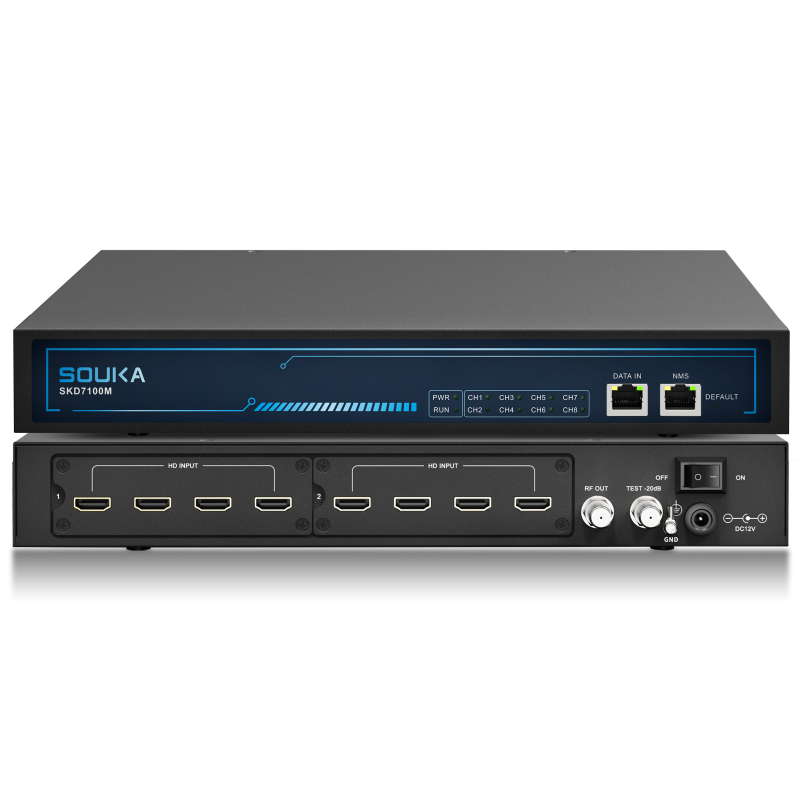
Compare these configurations against your source and television compatibility matrix. Confirm the required output standard and included options with SOUKA before ordering.
Related Solutions
Use the coax solution for RF distribution planning, or compare the IPTV architecture when interactive hotel services are part of the brief.
Cable TV Solution for Hotels
Deliver stable live television to every guest room without rebuilding the property network. SOUKA combines multi-source reception, high-density digital or analog modulation, RF combining, amplification, and centralized headend management for new hotels, phased renovations, and legacy coax upgrades.
Explore Solutions
IPTV Solution for Hotels
Deliver lag-free 4K live TV to every guest room, customize your interactive brand interface with zero coding, and automate database workflows. Our carrier-grade Linux streaming matrix bridges natively with global property management systems to eliminate integration friction and slash hardware deployment overhead.
Explore Solutions
Cable TV Solution for Hotels
Deliver stable live television to every guest room without rebuilding the property network. SOUKA combines multi-source reception, high-density digital or analog modulation, RF combining, amplification, and centralized headend management for new hotels, phased renovations, and legacy coax upgrades.
Explore Solutions
IPTV Solution for Hotels
Deliver lag-free 4K live TV to every guest room, customize your interactive brand interface with zero coding, and automate database workflows. Our carrier-grade Linux streaming matrix bridges natively with global property management systems to eliminate integration friction and slash hardware deployment overhead.
Explore SolutionsFrequently Asked Questions
Conclusion
The right HD modulator is the one that passes the complete source-to-television test and fits the hotel's distribution plan. Start with tuner and codec compatibility, distinguish programs from RF carriers, survey the coax network, and agree measurable commissioning criteria. This creates a defensible equipment shortlist and a clearer comparison of supplier quotations.
To review a live project, send SOUKA your television models, channel requirements, and coax layout. Ask for a recommended configuration, confirmation of any optional features, and a proposal for compatibility testing before committing to the full deployment.