A guest room energy management system coordinates occupancy information, room controls and selected electrical loads so a hotel can reduce avoidable operation without interrupting an occupied room. Successful projects begin with clear room states, an agreed HVAC sequence and practical tests. This guide helps owners, hotel engineers and system integrators define those requirements before comparing equipment prices or accepting an energy-saving claim.
What a guest room energy management system should control
Define the system by the decisions it must make, not by the number of devices in the room. It needs to distinguish a guest who is present, a guest who has temporarily left and an unrented room. Each state should have an agreed effect on comfort, selected lighting and suitable equipment.
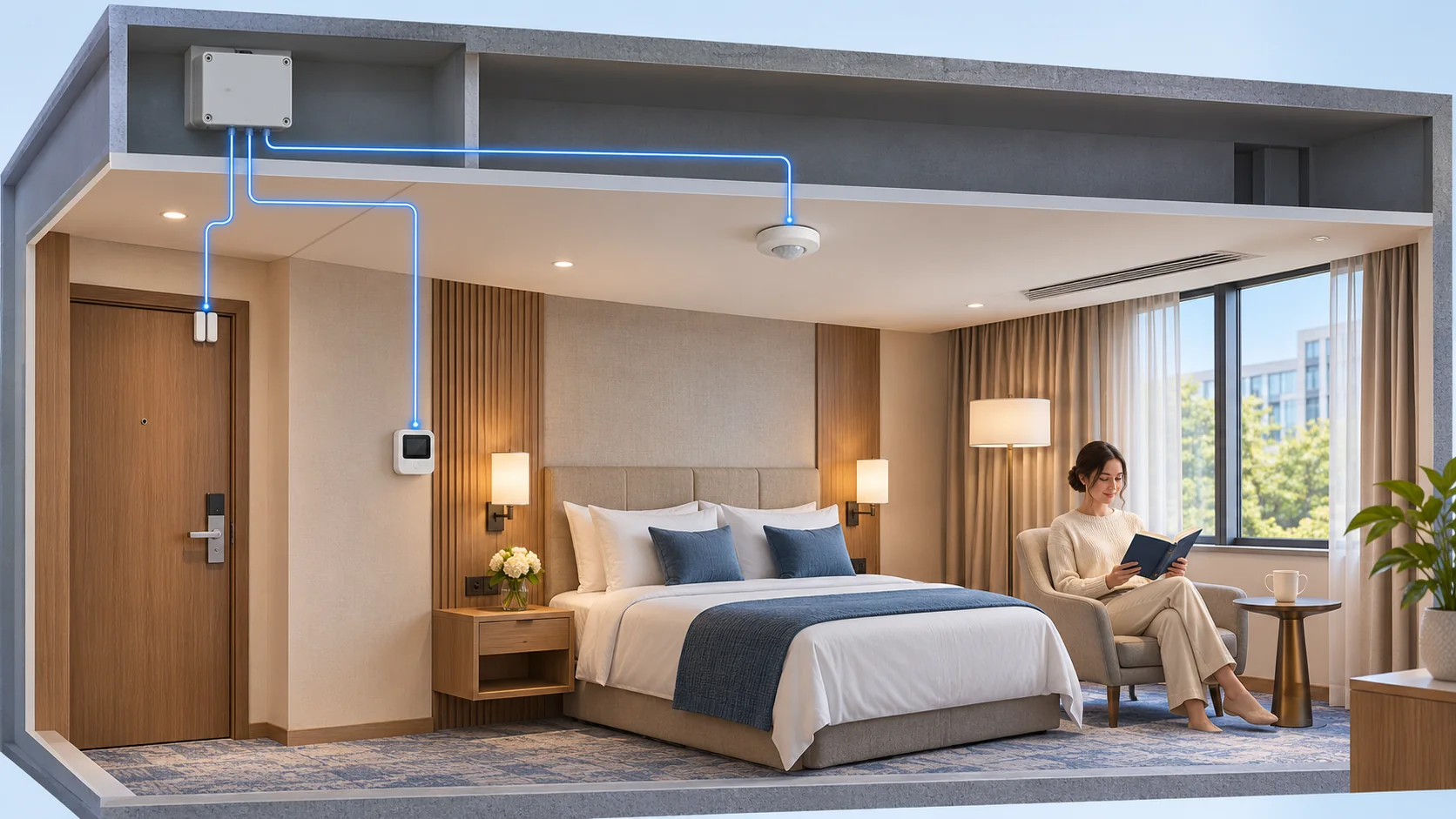
In a hotel project, the energy function normally sits within a wider guest room management system. The room control unit executes the approved sequence, while switches, thermostats, contacts and presence devices supply inputs or receive commands. A central interface can help staff see states and faults, but the room still needs a defined response when that interface is unavailable.
Use the SOUKA smart room control solution as the starting point for the overall project discussion. Then separate the specific energy-control requirements from welcome scenes, curtains, housekeeping requests and other guest services. Related functions can share a platform without needing identical rules.
| Information | Useful meaning | Important limitation |
|---|---|---|
| PMS room status | Whether the room is sold, checked in or released | A checked-in guest may currently be outside |
| Entrance contact | The door has opened or closed | It does not identify everyone who entered or left |
| Presence input | The selected detector reports activity or presence | Coverage and quiet-guest behavior need room testing |
| Thermostat and equipment feedback | Requested temperature and available operating state | A command does not prove that the room reached comfort |
Record which component owns each decision. A drawing with a sensor connected to an RCU does not explain when vacancy begins, what cancels it or which loads remain available. Those details belong in a written sequence that purchasing, mechanical engineering and hotel operations can all review.
Agree the service boundaries before procurement. Identify the HVAC contractor, the room-control integrator, the PMS interface owner and the person approving operational settings. If a requirement depends on another supplier, put that dependency in the quotation rather than leaving it to the installer to discover on site.
Turn occupancy signals into a defensible room state
Occupancy logic should combine relevant signals and allow for ordinary hotel behavior. A guest can be asleep, reading quietly, in the bathroom or accompanied by another person who stays behind. A single absence of detected movement should not immediately trigger an occupied-room shutdown.
Start with a state diagram covering rented and occupied, rented but temporarily vacant, unrented, housekeeping and a defined fault condition. State what evidence starts a transition and what evidence cancels it. A door event can begin an observation period, for example, while a valid presence event should prevent a premature move to vacancy.
Design for quiet guests and shared rooms
Specify the test positions that matter: the bed, desk, armchair, bathroom entrance and any separate bedroom. Check the installed sensor with the furniture, curtains and bathroom door in their normal positions. A detector specification alone cannot establish coverage throughout a furnished suite.
Review how a keycard holder behaves when a guest leaves a spare card inserted. Also test what happens when one person leaves and another remains. The agreed sequence should explain how conflicting inputs are handled, including a stale PMS status or an unavailable sensor, rather than treating every signal as equally reliable.
Choose delays from a documented operational requirement and a pilot-room result. This guide does not prescribe a universal vacancy timeout. A delay that works in a compact business room may create complaints in a suite or may leave an empty room operating unnecessarily.
Make overrides visible and limited
Housekeeping and maintenance need a clear way to keep a room usable during work. Define who can apply an override, which functions it affects and how it expires. An override that remains active indefinitely can erase the intended energy benefit without producing an obvious equipment fault.
Keep the explanation usable by staff. The engineering screen should distinguish an occupied room, a vacant room, an override and a missing input. If all four appear simply as an air-conditioning command, staff cannot tell whether the controller is following the design or masking a problem.
Finally, test the guest's return. Restoring comfort should follow the approved sequence, without unexpected full-light scenes or loss of the guest's chosen settings. Record the result as a room experience as well as a change in the controller's status display.
Specify HVAC sequences with the mechanical designer
Energy control should request an agreed HVAC operating mode through a compatible interface. It should preserve equipment protections, ventilation requirements and the building's environmental limits. Disconnecting a complete air-conditioning supply is not a substitute for designing that sequence with the mechanical team.
Identify the actual system in each room type, such as a fan-coil arrangement, packaged unit or a manufacturer-controlled air-conditioning system. Obtain the model-specific control requirements before selecting interfaces. A suitable contact arrangement for one unit does not establish compatibility with a different manufacturer's communicating controller.
Document occupied, temporary-vacancy and unrented settings separately. Include the return to occupied operation, the allowed guest adjustment range and the handling of open windows where that function is part of the design. Setpoints and limits should reflect the equipment, climate and hotel requirements, rather than a copied universal temperature.
| Sequence item | Define before ordering | Verify in the pilot |
|---|---|---|
| Vacancy request | Approved operating mode and interface owner | Equipment enters the requested mode without bypassing protections |
| Guest return | How comfort operation resumes | Actual temperature recovery and guest control availability |
| Open window | Input validation, delay and permitted HVAC response | No nuisance cycling from brief openings or a faulty contact |
| Loss of an input | Fallback mode and staff indication | A missing sensor does not create an unexplained room shutdown |
Keep comfort and building conditions in the acceptance plan
Heating, cooling and ventilation do different jobs. A room may need environmental control even when it is unrented. Ask the mechanical designer how the energy sequence will deal with humidity, condensation risks, temperature limits and any minimum ventilation or equipment requirements that apply to the project.
The 2009 PNNL technical support document for lodging buildings includes occupancy-based room control within a broader modeled building design. Its baseline, climate assumptions and combined measures should not be read as the performance guarantee of an individual controller or a different hotel.
Use that distinction when reviewing supplier proposals. Require a written sequence and a room test for the selected HVAC equipment. Keep mechanical commissioning and control commissioning coordinated, so a valve, actuator or equipment fault is not mistakenly attributed to occupancy logic.
Separate controllable circuits from protected supplies
Create a circuit schedule showing exactly what the room controller may switch. Selected lighting and approved discretionary loads can have energy rules, while other supplies may need continuous availability. The electrical designer should classify these circuits and confirm the switching arrangement before hardware is chosen.
Review guest charging outlets, refrigeration, network equipment and any service that must remain available when a guest leaves. Requirements vary by hotel and installation. A master-off scene should therefore follow the approved circuit list rather than remove power from every outlet in the room.
Size outputs for the actual connected load
Check load type, switching characteristics, ratings, inrush requirements and the need for suitable external switching equipment. A relay's headline rating is not enough to specify every lighting driver, motor or appliance. Record the load details and have the responsible electrical professional confirm the design.
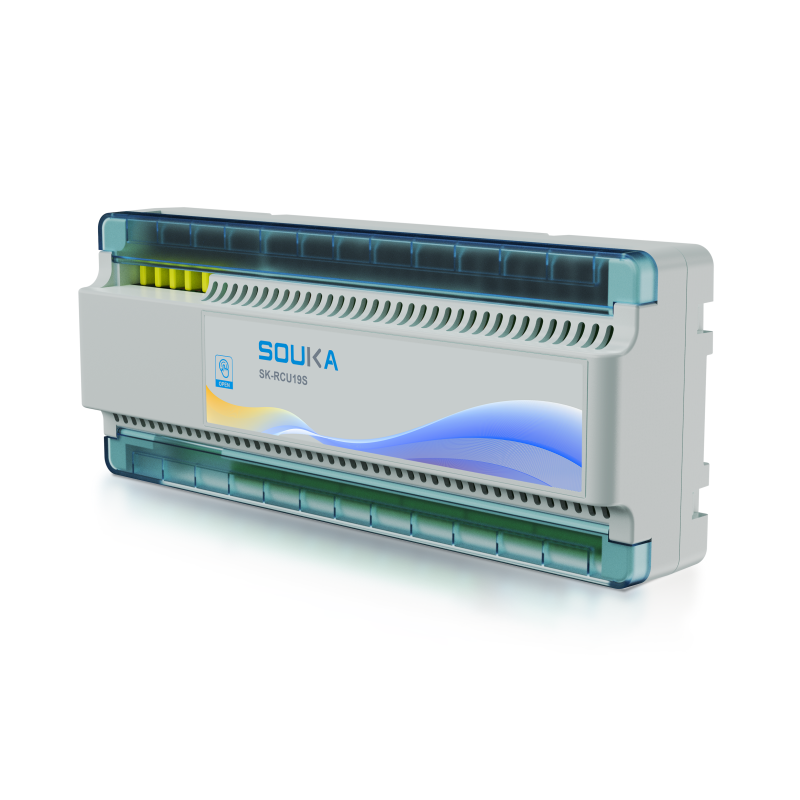
Compare the relevant SOUKA RCU controller options against that schedule. Ask for the exact input and output configuration, supported control method and installation requirements of the proposed model. Do not infer an energy function merely from a product's dimming capability or enclosure appearance.
For renovations, inspect the existing wiring and distribution arrangement before promising a simple retrofit. Identify which circuits can be controlled independently and which share supplies. Include access, labeling and the agreed room downtime in the installation scope.
Keep safety and ordinary guest use clear
Room energy automation should not replace independent protective systems or their approved operating sequence. Document any interfaces with those systems through the appropriate project specialists. A room-control marketing description does not authorize changing their power supply or control priorities.
Give hotel staff a clear explanation of what master off, vacancy and sleep actually do. Test the result at the outlet and light fitting, not only at an indicator on a panel. The handover drawing should match the installed circuit labels so a later repair does not inadvertently move a protected supply onto a switched output.
Define integration ownership and fallback behavior
A hotel guest room control system needs explicit responsibilities for local operation, PMS exchanges and any building-management connection. Specify which decisions stay in the room and what happens when a central service stops responding. A connection diagram alone does not define useful fallback behavior.
For PMS integration, list the actual events needed by the energy sequence. Examples include check-in, check-out, room move and an out-of-service status. Agree their meaning, room identifiers and recovery behavior with the PMS provider. An API label or an existing connection to another hotel is not proof that the required events are available in this installation.
Test missing, delayed and repeated messages
A room move or late check-out can expose weaknesses in event handling. Define how the controller reconciles a delayed message with a guest's current use of the room. Include startup after power restoration, central-server restart and loss of the PMS link in the test plan.
If BACnet is specified, request the exact device profile, objects, supported services and relevant product documentation. BACnet Testing Laboratories explains its independent product-testing process. Check any claimed listing against the actual proposed product, then verify the hotel's point mapping and sequence through project commissioning. This article does not claim that every SOUKA model is BTL certified.
Other interfaces also need a point schedule. Specify the signal, permitted values, update responsibility, timeout and visible fault indication. Match the physical interface and software behavior at both ends instead of assuming that a shared protocol name covers the whole integration.
Collect only the operating information that is useful
Staff normally need a room identifier, state, override and equipment fault to investigate energy-control behavior. Decide access and retention according to the hotel's operating needs and applicable requirements. Avoid exposing unnecessary guest information on a maintenance screen.
Preserve configuration backups, software versions and an agreed change process. A later change to a PMS mapping or sensor setting can alter room behavior without changing the installed hardware. The operations team should know who can make that change, how it is approved and how the previous tested configuration can be restored.
Commission the complete guest journey in a pilot room
A pilot should prove the whole room sequence with representative people, room layouts and connected equipment. Select room types that expose different conditions, such as a standard room and a suite. Agree pass conditions before testing, including comfort, permitted interruption and the evidence required for handover.
Begin by checking input labels and output mapping. Open the correct door contact, inspect the reported state and verify the expected circuit or HVAC request. Resolve mapping errors before adjusting timeouts. Otherwise, a commissioning team can spend hours tuning logic around the wrong physical signal.
| Test scenario | Observe in the room | Keep in the record |
|---|---|---|
| Quiet or sleeping guest | No false vacancy transition in the agreed test conditions | Positions, sensor placement, room layout and observations |
| One guest leaves, another stays | Comfort and selected guest functions remain available | Door events, presence state and resulting commands |
| Confirmed temporary vacancy | Only the agreed energy sequence is applied | Transition timing and actual equipment response |
| Guest returns | Controls and HVAC resume the approved behavior | Return event, room conditions and recovery observation |
| Central link or sensor unavailable | Defined fallback and a useful staff indication | Fault introduced, observed state and restoration result |
| Housekeeping or maintenance override | Required functions work and the override expires correctly | User action, scope and expiry test |
Observe the room as well as the dashboard
A command changing on screen does not prove that a lamp switched, a valve moved or a room recovered its temperature. Record physical observations alongside controller events. Where possible, synchronize the relevant logs so the team can relate a guest action to the resulting output.
Carry out failure simulations under an approved test plan. Preserve the initial configuration and restore normal operation after each scenario. Testing should not create unplanned disruption in occupied rooms or interfere with systems outside the agreed commissioning scope.
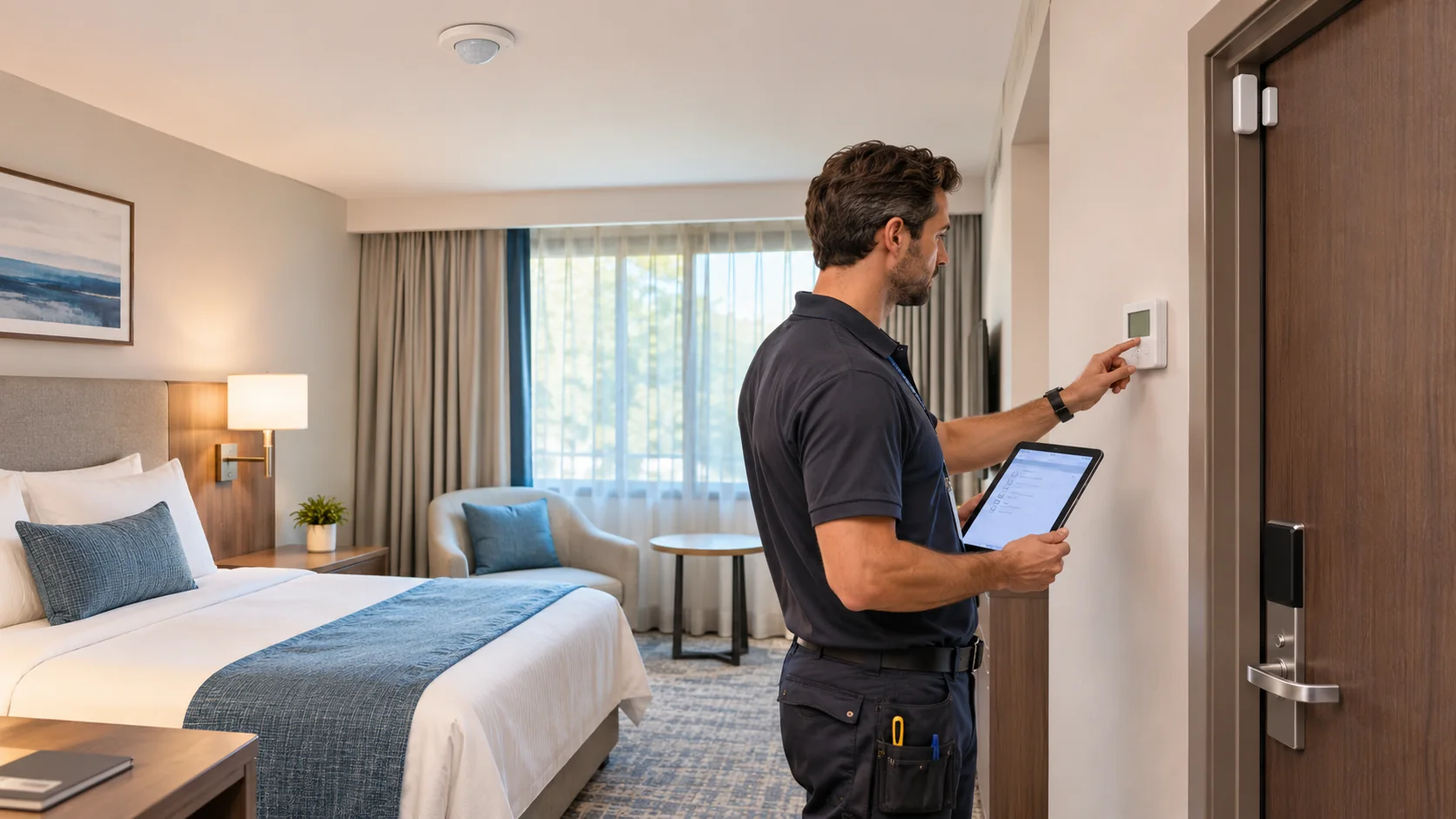
Give operations staff time to use the pilot room and report ambiguous behavior. Housekeeping, reception and engineering see different exceptions. Their feedback can reveal an override that is hard to release or a return sequence that is technically correct but inconvenient for guests.
Freeze the accepted configuration before wider installation. Keep a versioned sequence, circuit schedule, test results and unresolved exceptions. Repeat the affected tests after any change, and use the accepted pilot as the reference for subsequent room inspections.
Measure savings before approving the rollout
Assess a guest room energy management system against an agreed baseline, measured operation and the hotel's comfort requirements. An installed device count or a controller runtime display does not establish the reduction in purchased energy. Define how the project will distinguish control effects from weather, occupancy and other changes.
The Regional Technical Forum decision on lodging guest-room controls identifies uncertainty in baseline practices and variation in product settings and capabilities. Its July 2020 decision did not establish a universal deemed savings figure for the measure. That is a useful reason to examine the hotel's own starting conditions.
Build a comparable measurement plan
Record the existing room-control practices before the pilot. Note room occupancy, HVAC type, operating settings, overrides and the period covered. Keep track of changes such as refurbished equipment or a different room-use pattern that could affect the comparison.
Use appropriate energy measurements for the end use being assessed. Where HVAC serves multiple rooms or shares central plant, agree how room-level effects will be evaluated. Controller commands, compressor requests and metered electricity are different quantities and should be labeled accordingly.
Compare suitable periods or room groups with help from the project's energy specialist. Account for material weather and occupancy differences before describing a change as a saving from controls. Report guest complaints, environmental exceptions and unresolved faults alongside the energy result.
Compare the complete procurement scope
Ask suppliers to separate equipment, interfaces, licenses, installation, commissioning, training and ongoing support. Include any PMS-provider work and the meters or reporting services needed for verification. A lower room-controller price may exclude an important part of the operating result.
- Provide room types, layouts, HVAC models and the circuit schedule.
- Request the proposed occupancy sequence and all relevant assumptions.
- Identify interface ownership and third-party dependencies.
- Agree pilot tests, fallback behavior and acceptance evidence.
- Set a support, configuration-backup and change-management process.
The existing overview of smart hotel guest control systems provides the wider hospitality context. Keep this procurement decision focused on the particular energy sequence and measurable operating conditions rather than using the broad GRMS feature list as proof of savings.
Roll out the accepted design in manageable batches. Check a sample against the pilot configuration and close recurring exceptions before extending installation. This gives the hotel a controlled way to correct occupancy or integration behavior while preserving a clear record of what each room is running.
Related Products
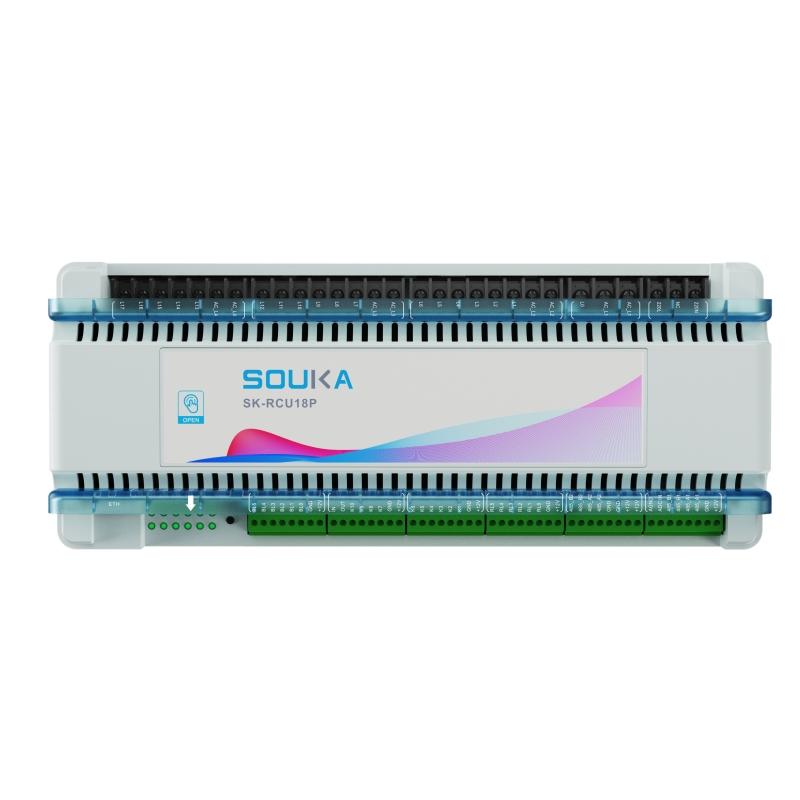
Related Solutions
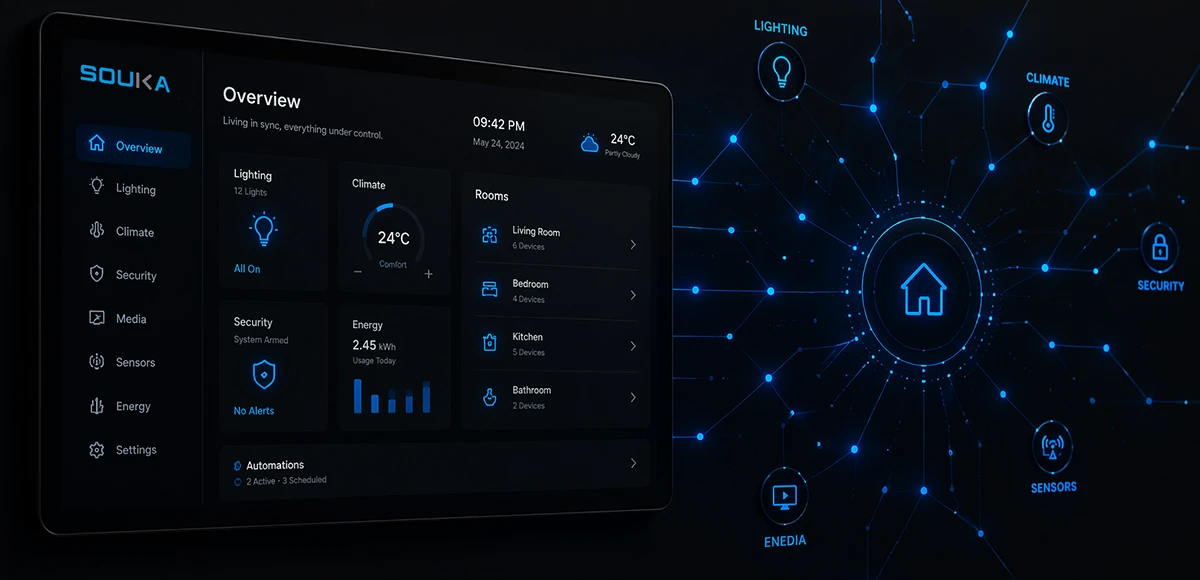
Smart Room Control Solution
Unify distributed RCU controllers, luxury touch panels, motorized curtains, precision HVAC climate controls, and occupancy sensors into an autonomous smart-room IoT architecture. SOUKA delivers localized edge-node computing, sub-50ms in-room latency, native PMS check-in database synchronization, and up to 30% dynamic energy savings for premium boutique hotels and multi-property chains.
Explore Solutions
Smart Room Control Solution
Unify distributed RCU controllers, luxury touch panels, motorized curtains, precision HVAC climate controls, and occupancy sensors into an autonomous smart-room IoT architecture. SOUKA delivers localized edge-node computing, sub-50ms in-room latency, native PMS check-in database synchronization, and up to 30% dynamic energy savings for premium boutique hotels and multi-property chains.
Explore SolutionsFrequently Asked Questions
Sensors can detect whether a room is occupied and automatically adjust connected devices.
For example, when a guest leaves the room, the system can turn off unnecessary lights, adjust the air conditioning, or enter an energy-saving mode.
This helps reduce unnecessary energy consumption and hotel operating costs.
Conclusion
A reliable guest room energy management system starts with accurate room-state decisions and a sequence that respects guest comfort, HVAC requirements and protected supplies. Define the responsibilities, prove the complete guest journey in a pilot room, and assess energy results against an appropriate baseline before extending the design.
To review a hotel project, send SOUKA your room layouts, HVAC models, controlled-load schedule and PMS interface requirements. A project-specific discussion can identify suitable room-control equipment, integration dependencies and the commissioning evidence needed for a complete proposal.