What does hotel IPTV streaming actually include?
IPTV streaming delivers television programmes over an IP network to compatible televisions, set-top boxes or applications. In a hotel, reliable delivery depends on the whole service path: authorised sources, processing, transport, room devices and operational support. A working preview at the headend does not prove that every occupied room will receive the same service reliably.
This guide is for hotel IT teams, AV integrators and project buyers specifying IPTV for business. It focuses on delivery and acceptance, rather than consumer subscriptions or a list of internet channels. Begin with the commercial IPTV system range and translate the proposed architecture into a testable brief before selecting individual devices.
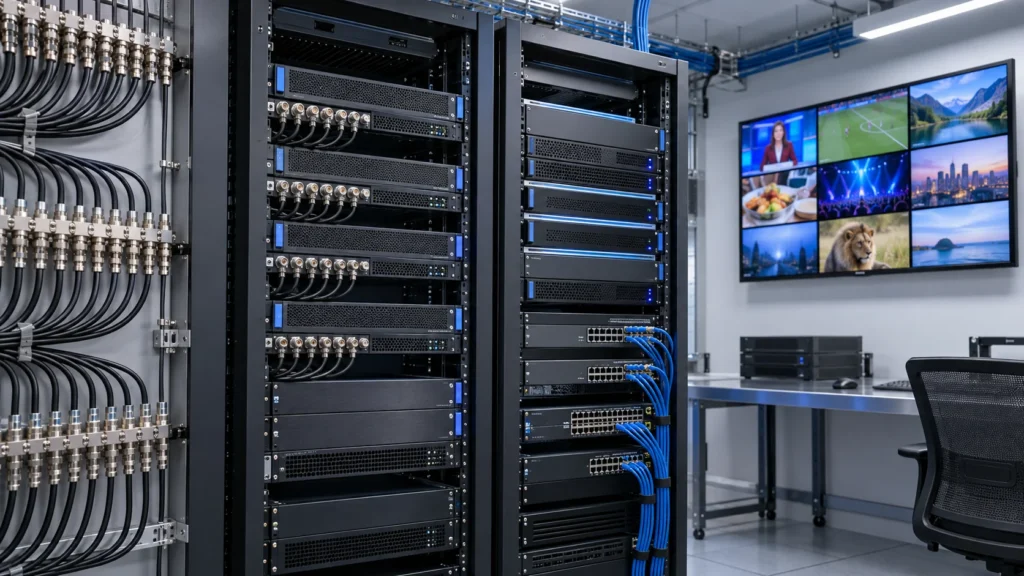
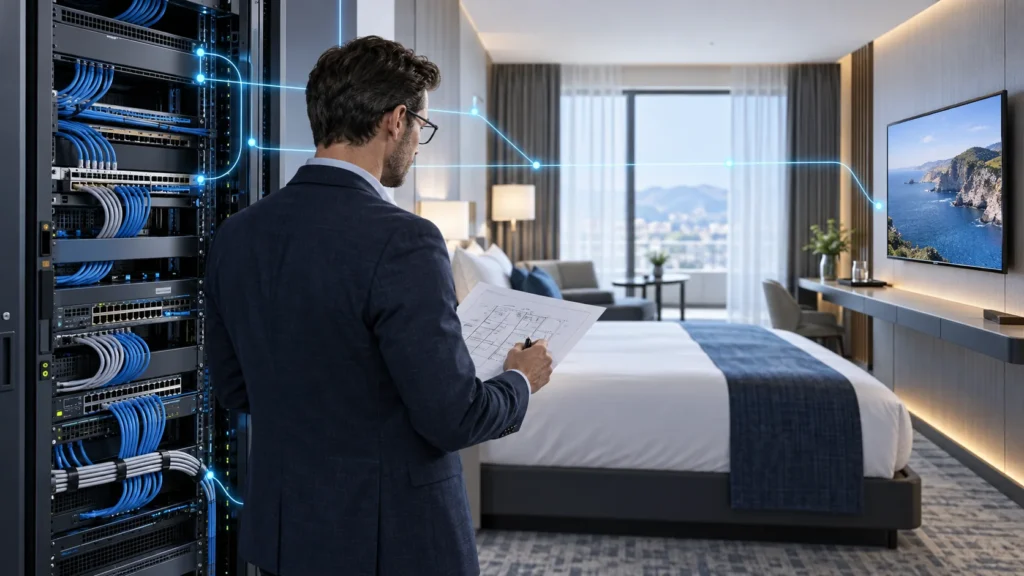
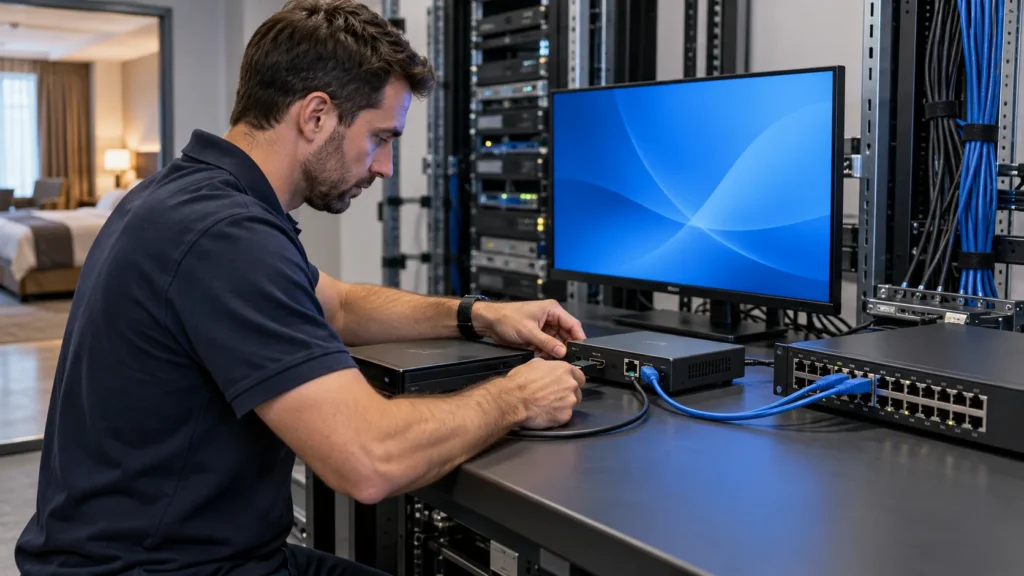
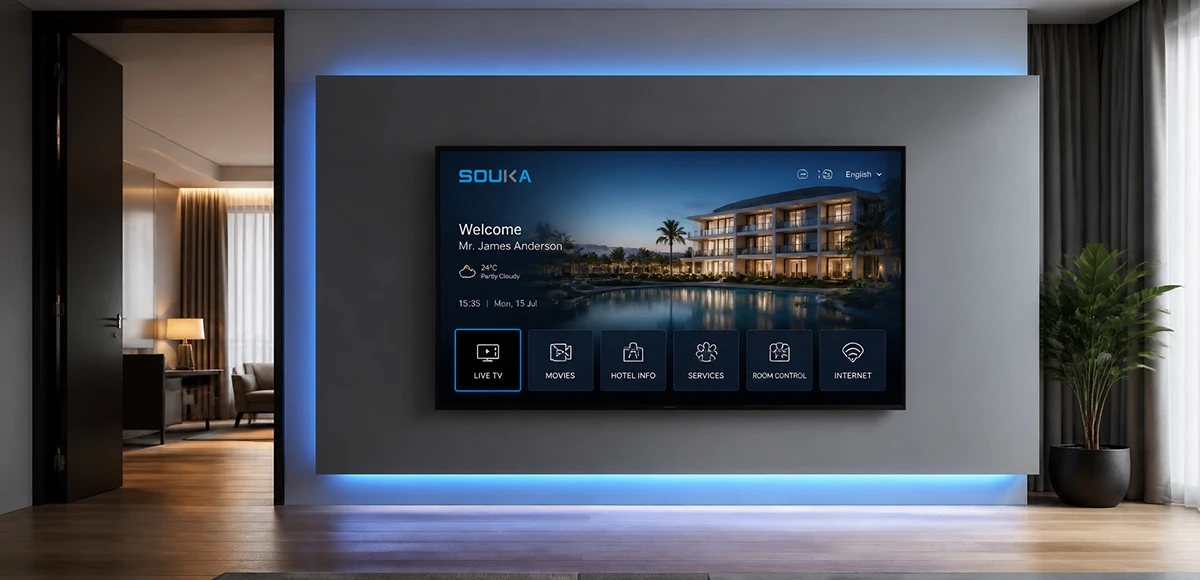
Planning priorities: separate live television from on-demand workloads, confirm the exact receiver and stream combination, calculate traffic on each link, and agree what happens during a fault. Numerical examples below are planning assumptions, not measured SOUKA performance. Both illustrations are generated concepts, not customer installations.
A channel service usually starts with a licensed broadcast feed, an authorised receiver output, a camera or an approved local media source. An encoder, receiver gateway or server then prepares streams for the chosen delivery network. Middleware may manage menus, channel lists and room permissions, while the receiver decodes the selected programme.
Those functions can share a chassis, but they remain different responsibilities. Recording them separately prevents a quotation for a streaming server from being mistaken for a complete installed service. Include cabling, switching, endpoints, source agreements, commissioning and support in the project scope.
Define the service before the device count
List live channels, on-demand content, welcome screens and any room-specific functions. Then state where each service must work: guest-room televisions, public-area screens or other approved endpoints. Different services may need different transport paths even when they appear in one menu.
Map one complete path from source to guest-room screen
Draw a representative channel from its origin to the room before deciding which IPTV equipment to buy. Identify every point where the signal changes format or ownership. An authorised HDMI output needs encoding; an already compatible IP stream may only need routing, remultiplexing or protocol conversion.
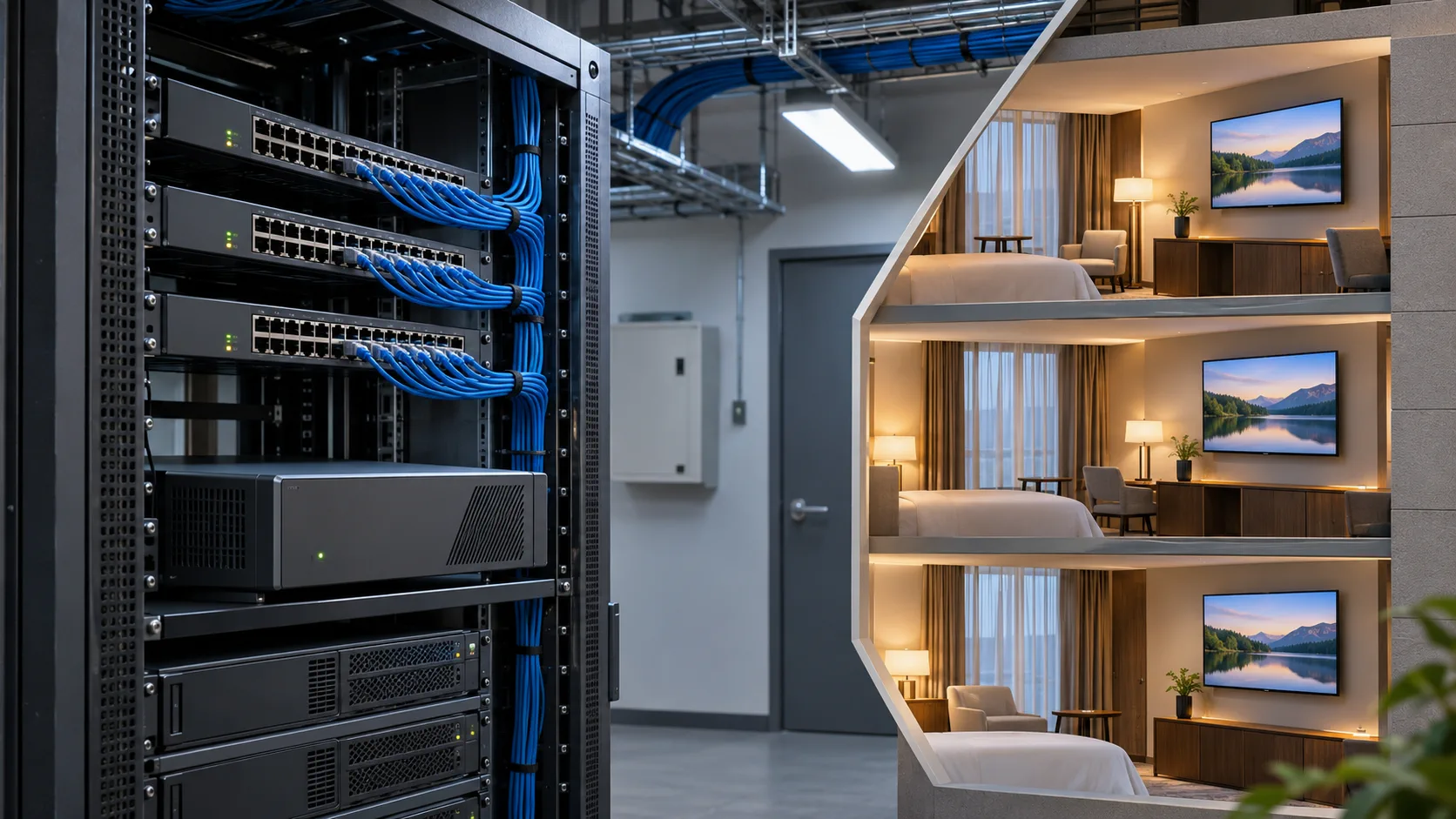
For each stage, record the source interface, video and audio formats, processing function, output protocol and destination. Name the team that owns it. The IPTV headend architecture guide explains the equipment roles; use this article to specify how the resulting stream reaches and recovers at the receiver.
Keep media delivery separate from control
The television picture may travel directly from an encoder or gateway to the room, while menus and authorisation use a separate server connection. If a menu loads but a channel does not, the fault may be on the media path. A healthy server login alone does not demonstrate healthy television delivery.
Likewise, property-management integration does not establish stream compatibility. Define check-in and checkout behaviour separately from live-channel playback, and test both. Keep source access credentials out of widely circulated drawings. Distribute configuration and access details through the property's approved process.
Use only content and connections that the property is entitled to distribute. Confirm the provider's permitted receiver and distribution arrangement before commissioning; a technically available output is not evidence that a redistribution arrangement has been approved.
Which delivery method fits each service?
Multicast IPTV streaming can deliver a shared live programme efficiently to several receivers on a managed network. Unicast creates separate delivery sessions. HTTP Live Streaming, or HLS, uses playlists and media segments over HTTP. These descriptions address different layers, so multicast, unicast and HLS are not three interchangeable video codecs.
| Delivery choice | Typical reason to evaluate it | What the project must prove |
|---|---|---|
| Multicast live delivery | Many rooms watch a shared lineup on a controlled LAN | Receiver support, group membership and forwarding across the complete path |
| Unicast delivery | Individual sessions or receivers requiring a particular application path | Concurrent sessions, server output and traffic on shared links |
| HLS delivery | Endpoints supporting HTTP playlist and segment playback | Supported codecs, playlist features, buffering and actual startup behaviour |
RFC 8216 describes HLS playlists and segments. Adaptive playback additionally requires suitable variants and player support; attaching an HLS label to a source does not automatically create an adaptive bitrate service. Validate the actual encoder, packager and player combination.
UDP and RTP also need precise treatment. RTP provides timing and sequence information for real-time applications, but RFC 3550 does not guarantee quality of service. A receiver still needs a usable network path and compatible buffering. Do not interpret a protocol name as a promise of zero loss or instant channel changes.
A mixed design can be reasonable: shared live channels on a managed multicast LAN and a compatible HTTP path for selected functions. Ask who maintains each path, how they are monitored and what changes when a room device is replaced. Detailed switch and routing design belongs in the network specification.
How should buyers estimate streaming capacity?
Estimate capacity from actual services and delivery paths, rather than multiplying rooms by a headline channel count. The useful load depends on concurrent sessions, distinct multicast groups, programme bitrates and where traffic is replicated. Processing capacity, network output, storage throughput and room-device limits must be checked separately.
A planning example with explicit assumptions
Assume 120 simultaneous unicast viewers, each receiving a 6 Mbit/s media stream. Their combined media payload at the sending side is 720 Mbit/s. That figure excludes protocol overhead, other services and operating margin, and does not by itself establish that a nominal gigabit interface is adequate.
For comparison, twelve live multicast programmes at 6 Mbit/s each create 72 Mbit/s of media payload on a link that carries all twelve groups once. A branch carrying fewer requested groups may carry less. This is an illustration of traffic replication, not a claim that every multicast deployment always uses 72 Mbit/s.
Draw a traffic worksheet for the headend uplink, core links, floor uplinks and room ports. Add simultaneous on-demand sessions, welcome video, updates and permitted shared services where relevant. Examine bitrate peaks and forwarding behaviour rather than assuming the average picture rate represents the busiest operating state.
Ask what the quoted maximum measures
A server's supported user count may describe registrations, active sessions or a tested delivery scenario. Request the exact workload, source formats, processing features and network arrangement behind the figure. Transcoding, recording or multiple output versions may change the available capacity.
The IPTV server capacity guide covers server selection in more detail. Keep its hardware checks alongside this link-by-link traffic plan. Neither worksheet replaces a representative full-load demonstration using the proposed configuration.
Match stream formats to the installed room devices
A receiver must support the complete stream combination, not just its resolution. Record the transport, container, video codec and profile, frame rate, audio format and relevant application requirements. The television family and firmware matter; a similar model sold in another market may behave differently.
Build a receiver matrix with one row for each retained television or set-top-box family. Include the exact stream configuration tested and the result. Check picture, audio tracks, subtitles where required, aspect ratio and lip sync. A programme name appearing in the menu is not proof that its audio and video can be decoded.
Separate source quality from delivery quality
A network can transport an unsuitable picture perfectly. Verify the original source before changing the streaming network. Similarly, changing from H.264 to H.265 may create a decoding problem even if the new stream uses less bandwidth. Compare the options against the actual endpoints, as discussed in our H.264 and H.265 hotel encoder guide.
For a proposed new receiver, request a sample or controlled demonstration before approving a large rollout. Retain its application version and settings with the test record. If a software update changes playback behaviour, the team needs enough evidence to reproduce the earlier working state.
A compatibility list should identify confirmed combinations and untested ones. Avoid accepting statements such as supports all smart TVs without a model-specific basis. When the service requires a particular player or hotel middleware, include its licensing, update path and support owner in the quotation.
Make the hotel network predictable during normal operation
A managed delivery network needs documented forwarding and service boundaries. Identify the television VLANs, source and receiver locations, uplinks, multicast controls and any required routing. Keep room television delivery separate from unrelated guest traffic where the network design calls for that separation, with explicit interfaces between services.
For IPv4 multicast, document the IGMP version, snooping behaviour, querier arrangement and group handling supported by the selected devices. RFC 4541 discusses IGMP snooping switch behaviour, including forwarding considerations. Enabling one checkbox does not prove that the whole hotel path will maintain correct membership during normal use and restarts.
Test the topology you will operate
Confirm that a receiver joining a group receives the intended stream and that unrequested groups do not flood unrelated room ports unexpectedly. Exercise channel changes and observe the relevant switch state. A design involving several routed segments needs documented routing as well as local membership handling.
Apply quality-of-service settings only as part of a coherent network plan. Priority markings do not create extra capacity. Check interface errors, queue drops, oversubscribed uplinks and competing traffic before treating a higher priority setting as a cure for visible breakup.
For wireless rooms, validate airtime, interference and the supported multicast or unicast delivery mechanism on the actual access points and endpoints. A wired bench test cannot establish Wi-Fi performance. Keep a tested wired alternative or another agreed migration plan for room groups that do not meet the requirement.
Assign change control to a named team. An unrelated switch replacement or VLAN adjustment can affect television delivery long after installation. Keep configuration backups and current topology notes accessible to the people responsible for those changes.
What should an IPTV streaming acceptance test measure?
Acceptance should demonstrate the agreed viewing experience on representative room devices under an agreed workload. Define observations before testing: startup, channel changes, continuous playback, recovery and operational handover. Set project-specific limits with the buyer; there is no single universal channel-change time or reliability figure for every installation.
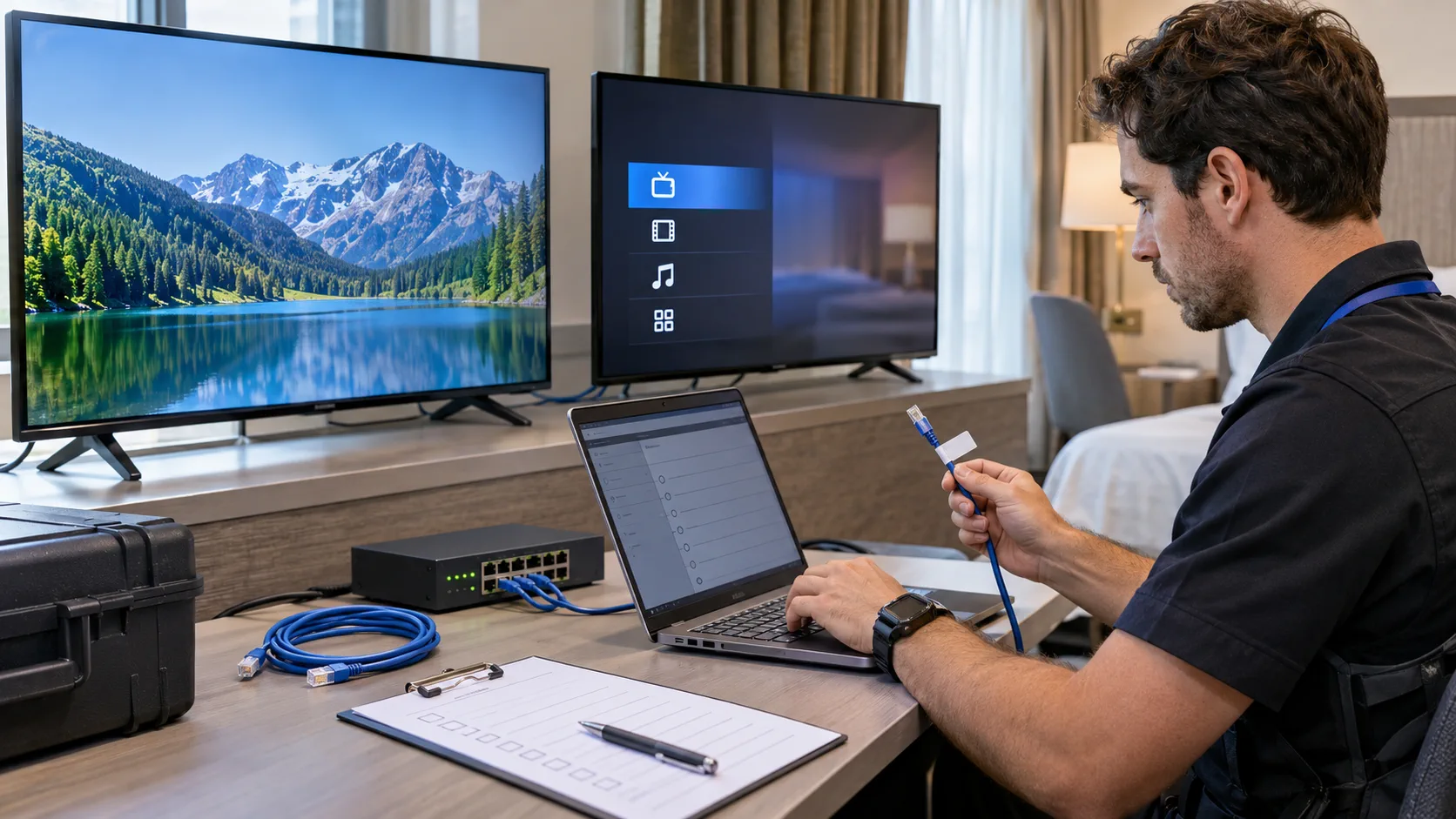
- Startup: power on representative room devices and verify the intended menu and authorised channel.
- Channel change: switch between agreed services and record observable delay, errors and audio behaviour.
- Playback: watch demanding representative programmes, including required audio tracks and subtitles.
- Concurrent use: apply the agreed live and on-demand workload while checking the busiest shared links.
- Room coverage: include each receiver family, floor segment and known difficult network path.
- Recovery: perform approved restarts and verify service returns with the correct settings.
Record the test date, firmware, stream settings, workload and observation period. Save relevant switch counters and player or server logs. Use a consistent method for timing, including where measurement begins and ends. A brief bench demonstration supports only that demonstrated condition.
Where the project includes welcome screens or property-management events, test those separately with fictitious guest data. Avoid making a successful live-channel test stand in for a working checkout process. The hotel IPTV procurement guide provides a broader framework for dividing the acceptance responsibilities.
Specify failure behaviour before buying redundancy
A second device is useful only when the project defines what it protects and how service moves to it. List credible failures: one programme source, an encoder, a server, a switch, an uplink or power to the rack. Then identify which rooms or services each failure could interrupt.
Ask whether recovery is automatic, manual or dependent on another system. Identify any configuration, licence, address or player change required. A spare unit that still needs an engineer to rebuild it provides a different recovery path from a tested automatic failover arrangement.
Check shared dependencies
Two servers can still depend on one switch or one power path. Conversely, multiple separate devices may create more configurations to maintain. Compare the complete failure domain and staff workload rather than counting duplicate boxes as proof of resilience.
Agree controlled fault tests during a maintenance window. Define who approves the interruption, what observers record and how the earlier service is restored if the test fails. Preserve the working configuration before starting. Use the results to refine the procedure rather than assigning an untested recovery-time claim.
Document what guests see during an outage and what hotel staff should check first. A concise fault report should distinguish one room, one channel, one floor or the whole property. That distinction helps the responsible team choose the next test without changing several unrelated settings at once.
Turn the design into a maintainable purchasing brief
A useful quotation connects equipment to specific services, responsibilities and acceptance evidence. Request a source-to-screen diagram, tested receiver matrix, capacity assumptions, software and licence list, commissioning scope, update process and support contacts. Compare exclusions as carefully as the equipment price.
| Brief item | What to ask the supplier to provide |
|---|---|
| Service scope | Source lineup, room groups, live and on-demand functions, permitted content arrangement |
| Delivery compatibility | Exact stream settings and tested TV or set-top-box combinations |
| Capacity | Defined concurrent workload and per-link traffic assumptions |
| Recovery | Failure domains, restoration steps, backups and agreed demonstrations |
| Commercial scope | Commissioning, training, updates, licences, spares and support exclusions |
For an integrated hotel project, the hotel IPTV solution is the relevant commercial starting point. Where television services interact with room controls, evaluate the integrated IPTV and GRMS solution against the actual interface requirements. Integration is a separate scope to specify, not evidence that every function is included in every server.
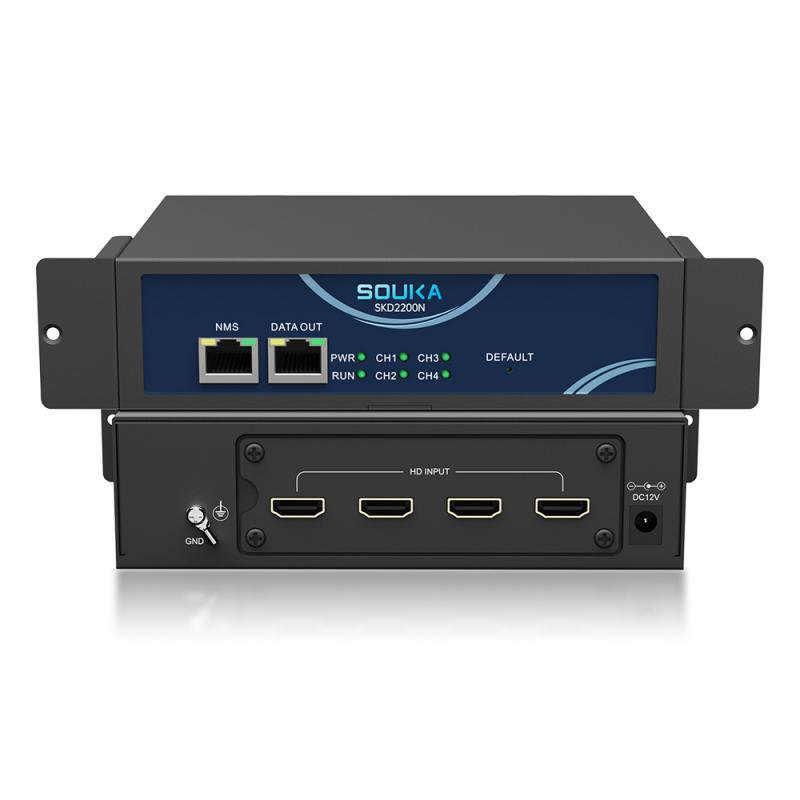
Keep the equipment discussion concrete. The IPTV streamer category supports source-processing comparisons, while the server range addresses delivery and middleware roles. Request the exact hardware, firmware and licence combination for the proposed system instead of relying on a category-wide maximum.
At handover, retain the final channel list, topology, approved configuration exports, endpoint versions, acceptance results and escalation process. Train staff to identify the affected service path and find the right support contact. A maintainable installation gives the hotel a repeatable operating method as well as a working picture on the first day.
Before purchase, ask the hotel and integrator to review the same version of the brief. Record unresolved compatibility questions and make responsibility for closing each one explicit. Keep optional future functions separate from the accepted first phase. This makes it easier to compare bids, schedule commissioning and recognise when a later request changes the scope rather than exposing a fault in the original installation.
Related Products
Related Solutions
IPTV Solution for Hotels
Deliver lag-free 4K live TV to every guest room, customize your interactive brand interface with zero coding, and automate database workflows. Our carrier-grade Linux streaming matrix bridges natively with global property management systems to eliminate integration friction and slash hardware deployment overhead.
Explore Solutions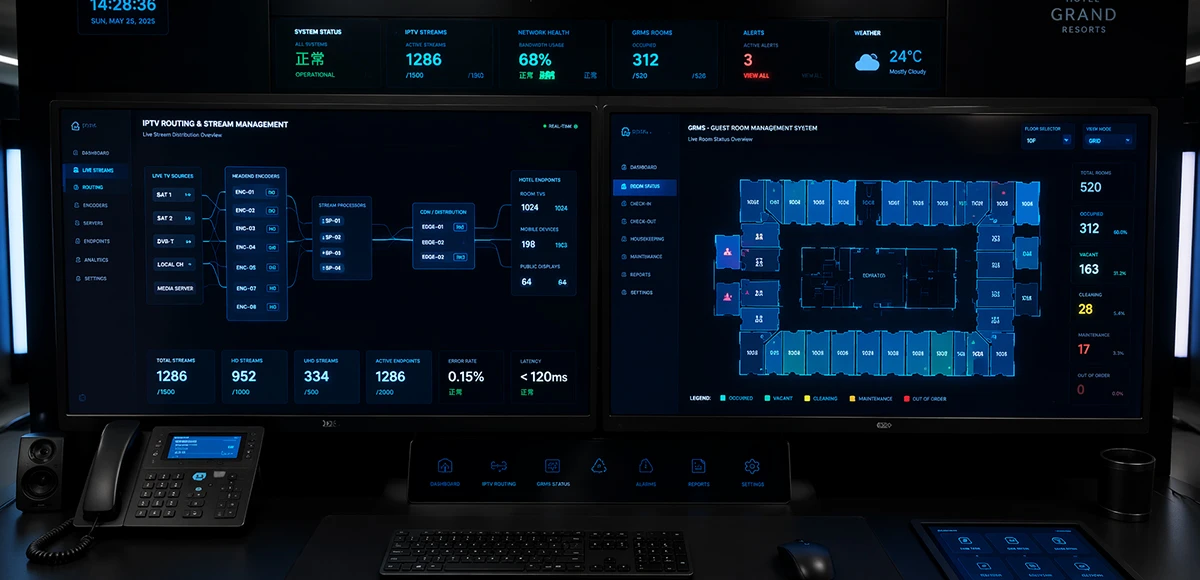
Integrated IPTV & GRMS Solution
Unify carrier-grade 4K IPTV streaming and autonomous RCU room controls into a single, cohesive hospitality IoT architecture. SOUKA bridges interactive in-room entertainment, smart lighting scenes, dynamic HVAC energy optimization, and native PMS database synchronization—slashing hardware CapEx, simplifying structured cabling, and delivering seamless guest experiences.
Explore Solutions
IPTV Solution for Hotels
Deliver lag-free 4K live TV to every guest room, customize your interactive brand interface with zero coding, and automate database workflows. Our carrier-grade Linux streaming matrix bridges natively with global property management systems to eliminate integration friction and slash hardware deployment overhead.
Explore Solutions
Integrated IPTV & GRMS Solution
Unify carrier-grade 4K IPTV streaming and autonomous RCU room controls into a single, cohesive hospitality IoT architecture. SOUKA bridges interactive in-room entertainment, smart lighting scenes, dynamic HVAC energy optimization, and native PMS database synchronization—slashing hardware CapEx, simplifying structured cabling, and delivering seamless guest experiences.
Explore SolutionsFrequently Asked Questions
Conclusion
Successful IPTV streaming for a hotel starts with a defined service and a compatible, documented delivery path. Choose transport for the installed receivers and workload, calculate traffic where it actually travels, and test normal use alongside controlled failures. Treat menus, live video, on-demand sessions and room integrations as related but distinct functions.
When requesting a proposal, provide the room count, television model list, source lineup, network topology and intended service features. SOUKA can use that project information to discuss an equipment configuration and commissioning scope. Discuss your hotel IPTV streaming requirements and ask for an explicit compatibility and acceptance plan. Keep final capacity and recovery commitments tied to the quoted configuration and demonstrated tests.