A multi channel IPTV encoder should be selected for the streams it can run simultaneously, the channels affected by a failure and the cost of restoring service. A high input count can simplify a hotel headend, but it does not establish spare capacity, automatic failover or the workload available at your chosen quality settings.
This guide helps hotel IT teams, AV integrators and B2B procurement teams compare channel density, recovery arrangements and total cost of ownership. Use the commercial IPTV encoder range to shortlist equipment, then ask suppliers to quote the same source inventory, output profiles and acceptance tests. The numerical examples below are planning assumptions, not SOUKA performance measurements.
Selection priorities
- Count independent sources and simultaneous output profiles separately.
- Size the system at the required codec, resolution and frame rate.
- Define the service lost when a shared component fails.
- Budget a usable spare and demonstrate recovery on actual receivers.
- Compare complete installed and supported configurations.
What does the channel count actually describe?
Confirm whether the quoted count describes physical inputs, independently encoded programmes, output profiles or network destinations. These are different resources. Twelve input connectors do not prove that twelve sources can each produce multiple codecs and resolutions at once. Write the required combination into the quotation and test it as a complete workload.
Build a source-to-stream inventory
For every authorised source, record its connector, resolution, frame rate, audio format and required destinations. Add the output codec, bitrate, packaging and any alternate profile. A second output at a different resolution may require another encoding task; forwarding the same encoded stream may instead consume additional network capacity. Ask how the proposed implementation handles each operation.
| Count | What to record | What it does not establish |
|---|---|---|
| Physical inputs | Connectors and accepted input timings | Concurrent processing at every advertised setting |
| Encoded programmes | Independent sources encoded together | Extra profiles or a second codec for each source |
| Output profiles | Codec, resolution, frame rate and bitrate per version | The number of televisions served |
| Network destinations | Multicast groups or unicast recipients | Spare encoding capacity or failover |
A hotel distributing the same programme to many rooms does not necessarily need one encoder channel per room. Distinct source programmes, alternate versions and the distribution method determine the workload. Room count remains relevant to the wider network, middleware and receiving system. Keep those responsibilities visible rather than placing every capacity requirement on the encoder.
The IPTV encoder buying guide covers the wider interface and procurement checklist. This article concentrates on how to divide the accepted workload among units and how to support that arrangement after installation.
How should you compare two-, four- and higher-density units?
Compare candidate units using the same accepted workload and the same failure policy. Higher density can reduce the number of boxes, cables and management interfaces, while smaller units divide the affected channels into smaller groups. Neither arrangement is automatically cheaper or more resilient once spares, mounting and recovery work are included.
Compare an illustrative 24-source requirement
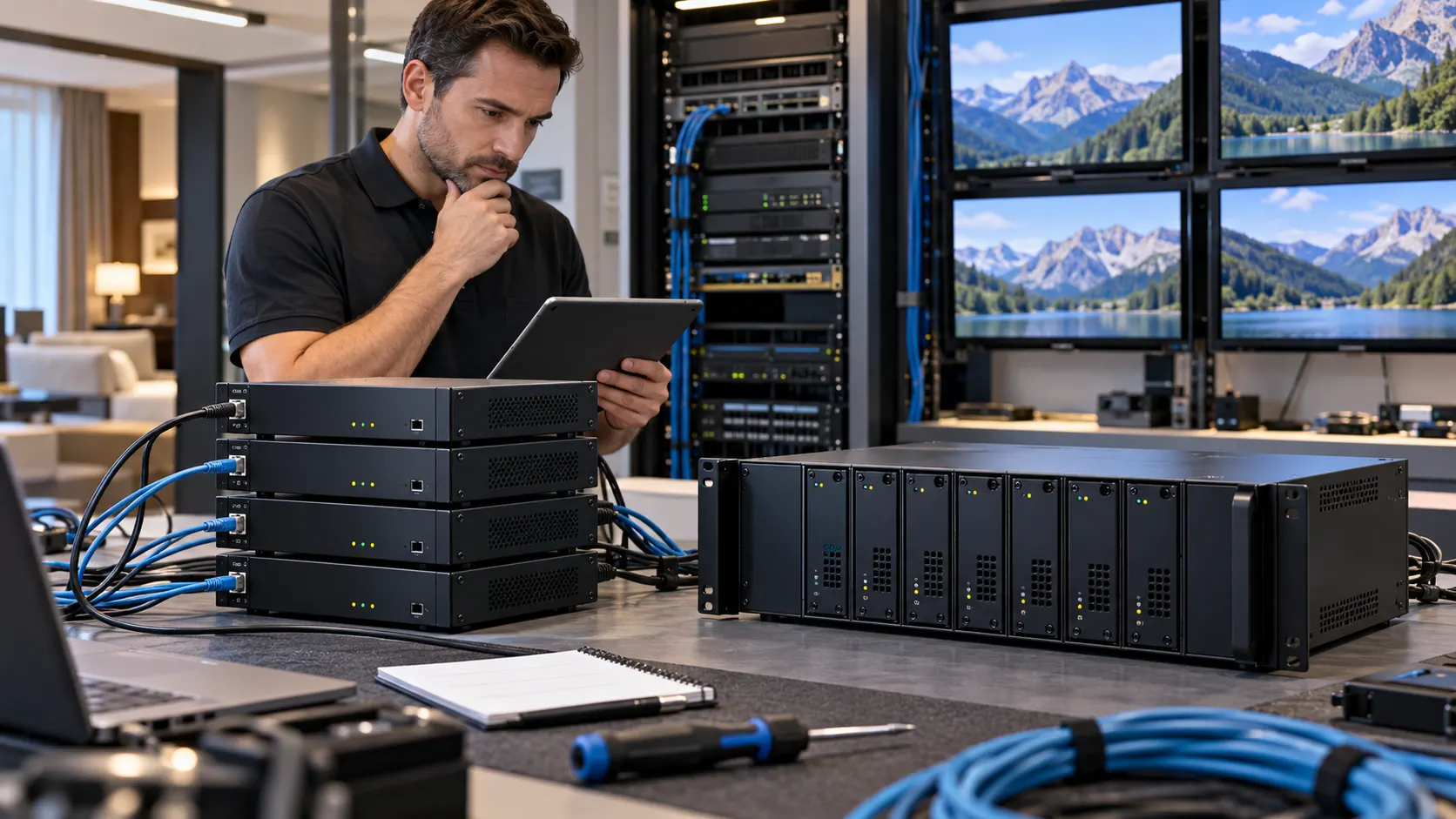
Assume 24 independent HD sources and one accepted output profile per source. If the supplier confirms the full workload, twelve two-channel units, six four-channel units or three eight-channel units could each provide 24 active channels. This arithmetic describes hypothetical layouts, not the availability or capability of a particular SOUKA model.
A compatible spare large enough to replace one complete failed unit would add two, four or eight channels respectively. It still would not protect against a failed source, common power circuit or shared switch. The spare also needs the correct licences, input timings, saved configuration and a documented way to receive the sources and deliver their streams.
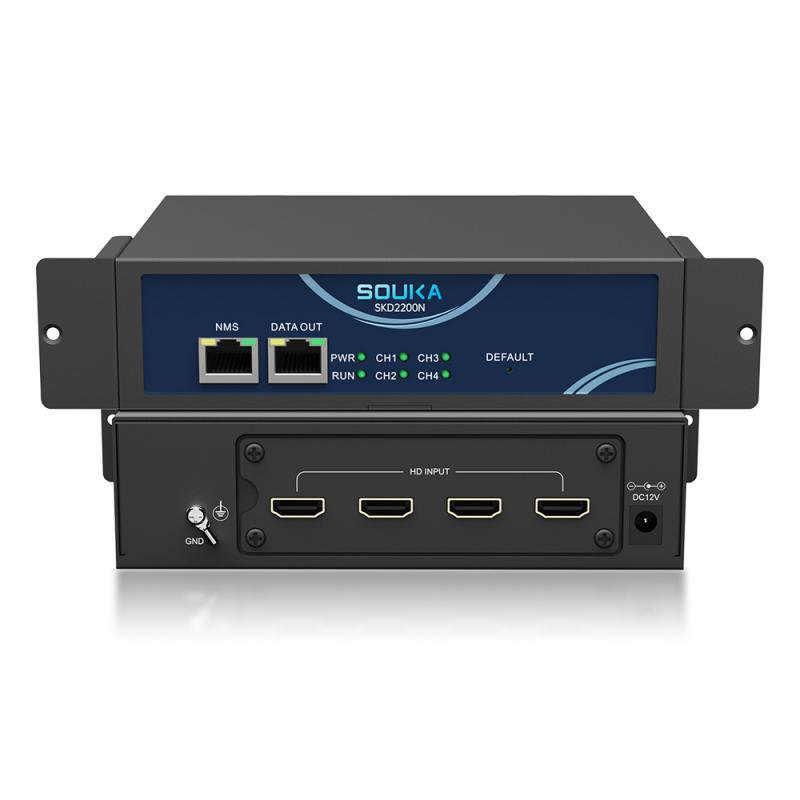
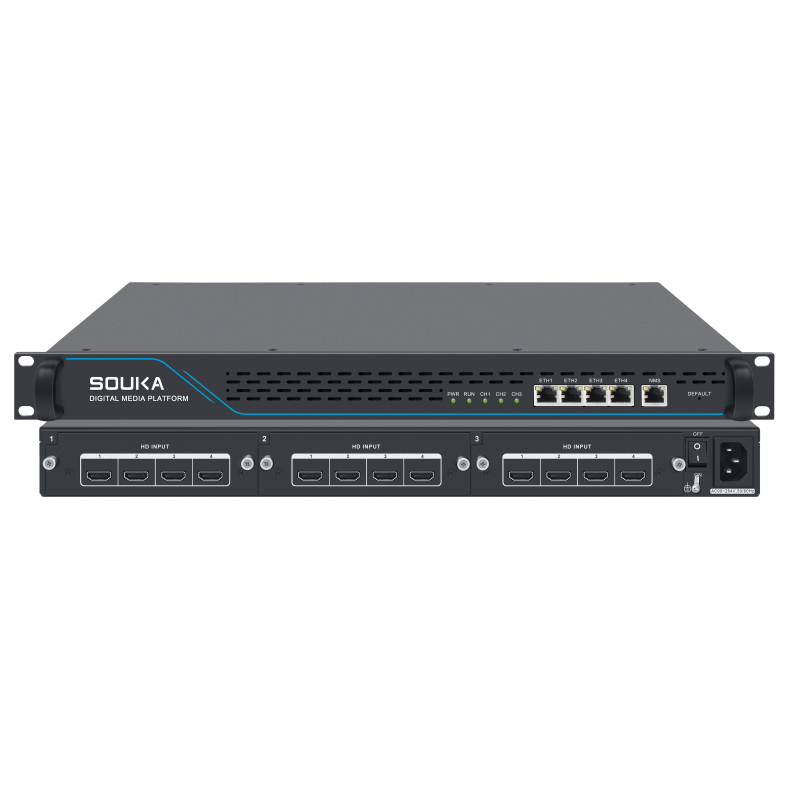
Use actual product data for the shortlist. The SOUKA four-channel HD encoder page describes four HD inputs and H.264 output. The current multi-channel model page describes a different modular arrangement. These are comparison candidates, not interchangeable specifications. Confirm current supply, firmware and the simultaneous configuration in writing.
Choose the grouping around channel importance as well as quantity. Distributing essential welcome or information channels across separate units may be useful, but only if the rest of their paths are also appropriate. Record which programmes share each chassis, supply and network dependency.
How much network capacity do simultaneous outputs need?
Add every stream carried by the link under review, then account for packaging, protocol overhead, measured peaks and other traffic. Encoding capacity and network throughput are separate limits. A multicast programme may be replicated farther downstream, whereas sending separate unicast copies can increase traffic at the originating interface.
Use a transparent bitrate calculation
As an illustration, assume 24 programmes, each with 6 Mbit/s video and 0.128 Mbit/s audio. Their combined elementary-stream rate is 24 × (6 + 0.128) = 147.072 Mbit/s. If every programme also needs a simultaneous 3 Mbit/s video version with the same audio rate, that adds 75.072 Mbit/s, for 222.144 Mbit/s before transport overhead.
These figures are chosen assumptions. They are not a recommended bitrate, a measured product limit or a reason to approve a link simply because its nominal speed is higher. Check the configured rate-control mode, transport-stream behaviour, output-port capability and observed peaks. Obtain measurements with all required versions enabled, including recovery or duplicated paths.
For IPv4 multicast, IETF RFC 3376 on IGMPv3 describes how hosts report multicast memberships. Membership handling does not by itself certify switch capacity or receiver compatibility. Confirm the actual VLANs, querier, switching behaviour and routing boundaries with the network owner.
Use the HDMI IPTV network design guide for that wider delivery path. For codec trade-offs, the H.264 versus H.265 encoder comparison explains why a smaller bitrate cannot be assumed from a codec label alone. Here, capacity approval must cover all agreed outputs running together.
Which failures should the encoder layout contain?
List shared dependencies and identify the programmes lost when each one fails. Channel grouping limits the effect of some unit failures, but a common power supply, switch, source distribution device or management mistake can affect several groups. Define the failure being protected against before describing a design as redundant.
Make the failure map part of procurement
| Failure or maintenance event | Question to resolve | Evidence to request |
|---|---|---|
| Encoder unit unavailable | Which channels stop and who restores them? | Channel map, spare configuration and recovery record |
| Input source or distribution failure | Can the replacement encoder obtain a usable source? | Approved input-routing procedure |
| Power path unavailable | Do active and spare units share the same dependency? | Power and protection diagram |
| Network path interrupted | Can receivers reach the restored stream? | Network ownership and recovery test |
| Firmware or configuration error | Is an accepted baseline available? | Versioned exports and rollback instructions |
Do not treat two network sockets as proof of redundant media paths. One may be intended for management, or both may depend on the same internal resources. Likewise, two power inputs need a documented operating arrangement and appropriately independent upstream supplies before they support a useful availability claim.
Maintenance is a separate scenario. A firmware change may require a restart even when the hardware is healthy. Ask how the hotel keeps agreed priority services available, how configurations are backed up and how a failed upgrade is reversed. Avoid updating every unit simultaneously without an accepted maintenance plan.
For system-level dependencies, use the IPTV headend architecture guide. The encoder supplier, source provider and network team should agree where their responsibilities meet. A spare box cannot resolve every black-screen incident, so the recovery instructions should distinguish missing input, missing packets and a receiver unable to decode them.
What does cold, warm or automatic recovery really require?
Specify the recovery actions and the interruption the hotel accepts instead of relying on labels such as hot standby. A powered-off replacement, a prepared standby and an automatically switched path involve different dependencies. Automatic recovery requires a defined detection and switching mechanism; simply installing two encoders does not create it.
Write a replacement sequence
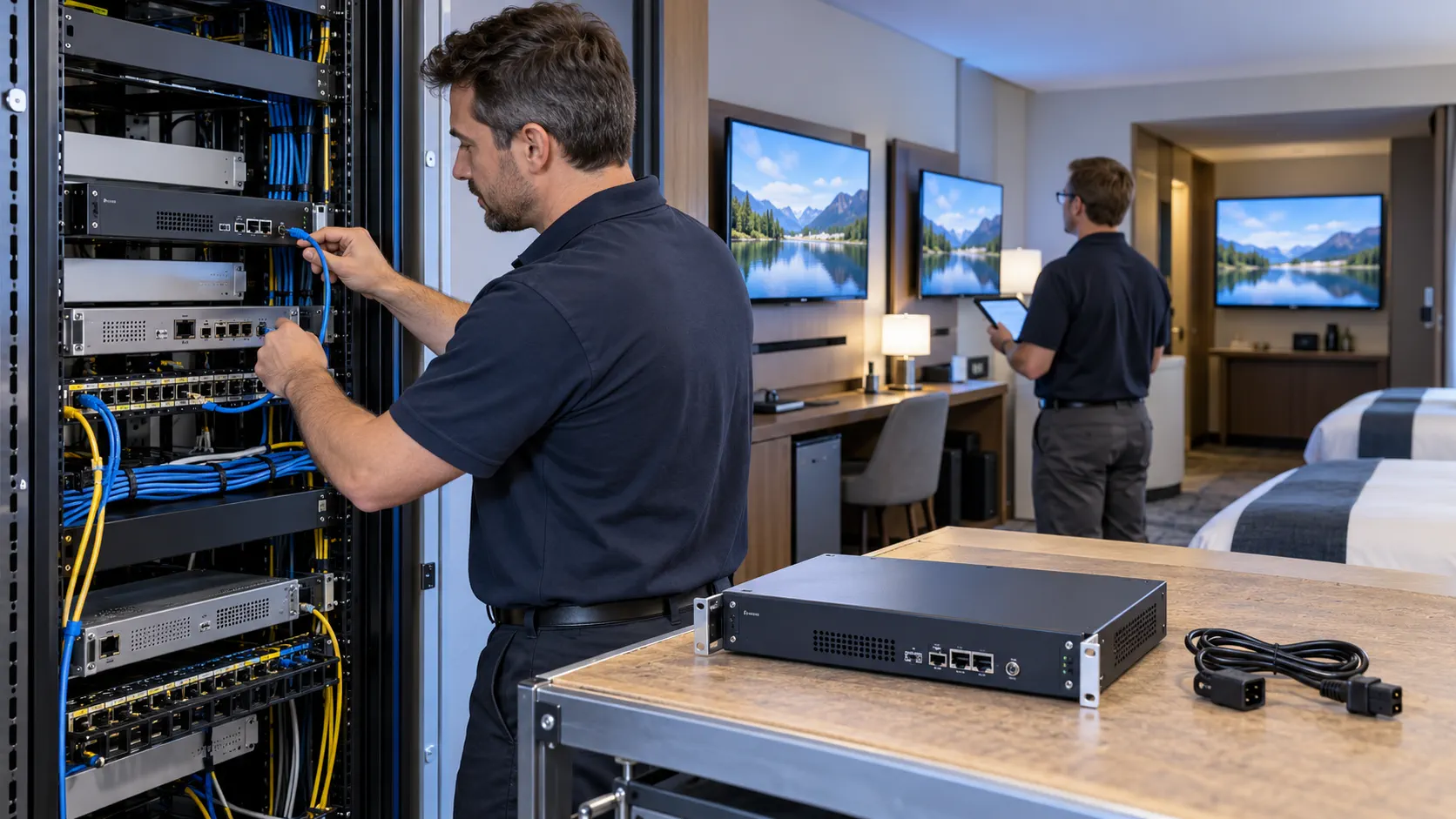
For a cold spare, document who notices the fault, confirms the affected unit, connects the replacement, restores the accepted configuration and verifies the guest-room picture and audio. Include access to the equipment room, the required patch leads and the location of the configuration export. An unopened spare with unknown firmware is an unresolved dependency.
For a warm standby, specify which inputs and outputs are already connected and how the active role changes. Prevent conflicting stream addresses or duplicate identities during transition. Confirm whether receivers continue using the same catalogue entry or require changes. A spare that is ready electrically may still need manual intervention at the service layer.
For automatic switching, ask what triggers it, how false detections are handled and what happens when the original path returns. Test both failure and return-to-normal behaviour. Do not promise seamless switching without evidence from the proposed encoder, switching equipment, stream format and actual receiver application.
IETF RFC 3550 on RTP describes functions including sequence numbering, timestamps and reception reporting, while making clear that RTP does not guarantee timely delivery or quality of service. Selecting RTP is therefore not an automatic failover mechanism. Record the separate recovery components and the result seen on the television.
How should you calculate density and total ownership cost?
Compare the complete configuration over an agreed operating period. Include active units, usable spares, mounting, power, installation, licences, monitoring, support and maintenance effort. A lower price per input is useful only when those inputs meet the required workload and the hotel can support the resulting failure groups.
Account for equipment-room resources
Check the actual enclosure dimensions, mounting accessories, ventilation clearances and service access. Several compact boxes may need shelves, adapters and cable management. A rack unit may simplify mounting but still require front or rear clearance. A modular chassis may concentrate fan, backplane or supply dependencies; establish the design rather than assuming each module is independent.
Use measured operating power for a realistic energy comparison, alongside rated limits when sizing electrical protection. For illustration only, a constant 75 W load running continuously for one year uses 0.075 kW × 24 × 365 = 657 kWh. Electricity cost then depends on the applicable tariff; cooling and other site costs need separate assumptions. No SOUKA model is assigned that consumption here.
| Cost category | Include in the comparison |
|---|---|
| Initial equipment | Active configuration, compatible spare and required licences |
| Installation | Mounting, approved source distribution, cabling and commissioning |
| Operation | Measured energy, monitoring and documented maintenance work |
| Recovery | Spare preparation, replacement labour and agreed support arrangements |
| Change and retirement | Firmware support, expansion, migration and disposal obligations |
Keep known costs separate from estimates. Do not invent a failure rate or assign an arbitrary financial loss to an outage to make one topology appear cheaper. Instead, show the recovery requirements, unresolved dependencies and the assumptions the buyer must price. This makes different supplier quotations easier to compare without presenting a speculative return on investment as a fact.
How do you accept a fully loaded multi channel IPTV encoder?
Run the intended sources and output versions together through the representative receiving path. Confirm picture, audio, network load, management access and recovery against written criteria. An idle demonstration or a single-channel stream cannot establish the capacity of a fully populated multi-channel configuration.
Use a repeatable acceptance schedule
- Record model, hardware revision, firmware, licences and configuration exports.
- Connect the authorised source inventory at the agreed input timings.
- Enable every required codec, resolution, frame rate and alternate profile.
- Check picture, audio, channel changes and receiver restarts.
- Measure traffic at the relevant interfaces and record peak behaviour.
- Exercise the agreed unit, power or network interruption under a controlled maintenance plan.
- Restore the accepted configuration and check the service from a room endpoint.
- Record exceptions, responsible owners and the evidence required to close them.
Choose representative material, including motion, text and difficult scenes the property is authorised to distribute. Use the intended television or receiver firmware and application. A stream that plays in a desktop player may still be unsuitable for the deployed hotel client. Agree the observation period and environmental conditions; a short test does not prove indefinite reliability.
IETF RFC 768 on UDP states that delivery and duplicate protection are not guaranteed by UDP. If the service needs additional loss handling, specify and test the actual transport and application mechanisms. Do not interpret a UDP output option as an assurance that packets cannot be lost.
The recovery test ends when the intended service is usable again, not when a status LED turns green. Record detection, intervention and endpoint recovery separately. Where automatic recovery is proposed, retain logs and the visible result. Where recovery is manual, have the responsible team follow the written procedure rather than relying only on the supplier engineer.
What should a comparable encoder quotation contain?
Request a configuration-specific bill of materials, a completed workload matrix and a recovery plan. The supplier should identify supported combinations, exclusions and responsibilities before the order. This prevents a high-density headline from hiding a limited output profile, an unlicensed feature or a spare that cannot replace the proposed unit.
Send one brief to every candidate supplier
- Authorised sources, input connectors and all required timings.
- Active programme count and simultaneous alternate output profiles.
- Receiver families, firmware, audio and stream-format requirements.
- Output-interface throughput and the proposed distribution method.
- Channel grouping, common dependencies and replacement arrangements.
- Monitoring, configuration export, update and rollback procedures.
- Mounting, power, environmental requirements and included accessories.
- Support scope, spare availability and configuration-specific acceptance evidence.
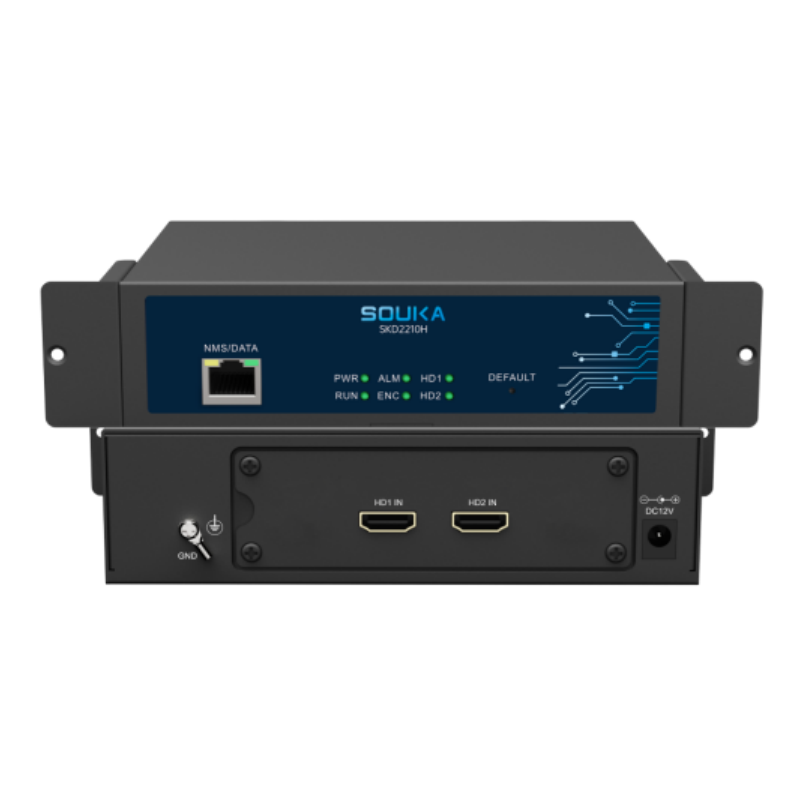
The related SOUKA products below offer different channel groupings. Use their current specifications to begin the discussion; do not infer automatic redundancy, UHD support or identical performance across the range. If an eight-channel configuration is required, ask for the currently offered model and its complete operating limits rather than substituting a differently specified product.
For a hotel rollout, place the encoder decision inside the hotel IPTV solution and agree who owns channel presentation, room provisioning and operational support. Hospitals and integrated hospitality systems can reuse the capacity method, but their own service priorities and approved integration requirements still apply.
Ask the supplier to return marked exceptions instead of a general confirmation that everything is supported. Resolve differences before comparing totals. A useful purchasing result is an agreed, testable configuration with a practical recovery route, not simply the largest advertised channel count.
Keep an explicit handover pack with the channel-to-input map, stream addresses, accepted settings, firmware files or approved download locations, configuration exports and the spare replacement instructions. Identify who can authorise changes and how the next operator obtains support. Check that the hotel can read and use those documents without access to a supplier employee’s personal computer. After expansion, update the workload matrix and recovery procedure together; adding programmes can change the channels sharing one failure group. If a quoted feature remains conditional on a future firmware release or an untested integration, list it as an open item rather than counting it as delivered capacity.
Related Products
Related Solutions
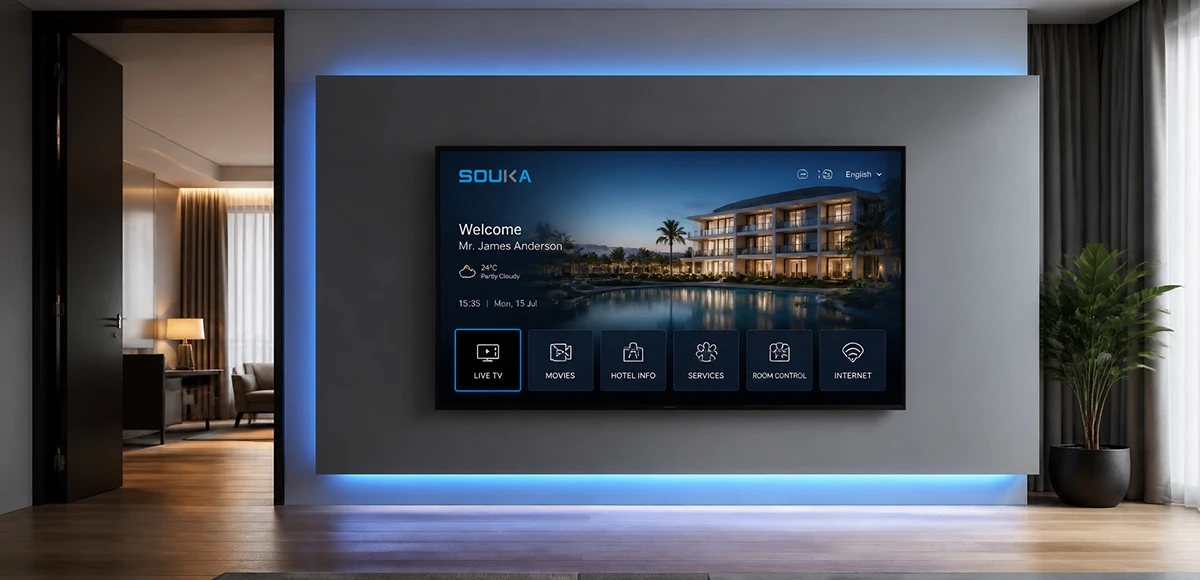
IPTV Solution for Hotels
Deliver lag-free 4K live TV to every guest room, customize your interactive brand interface with zero coding, and automate database workflows. Our carrier-grade Linux streaming matrix bridges natively with global property management systems to eliminate integration friction and slash hardware deployment overhead.
Explore Solutions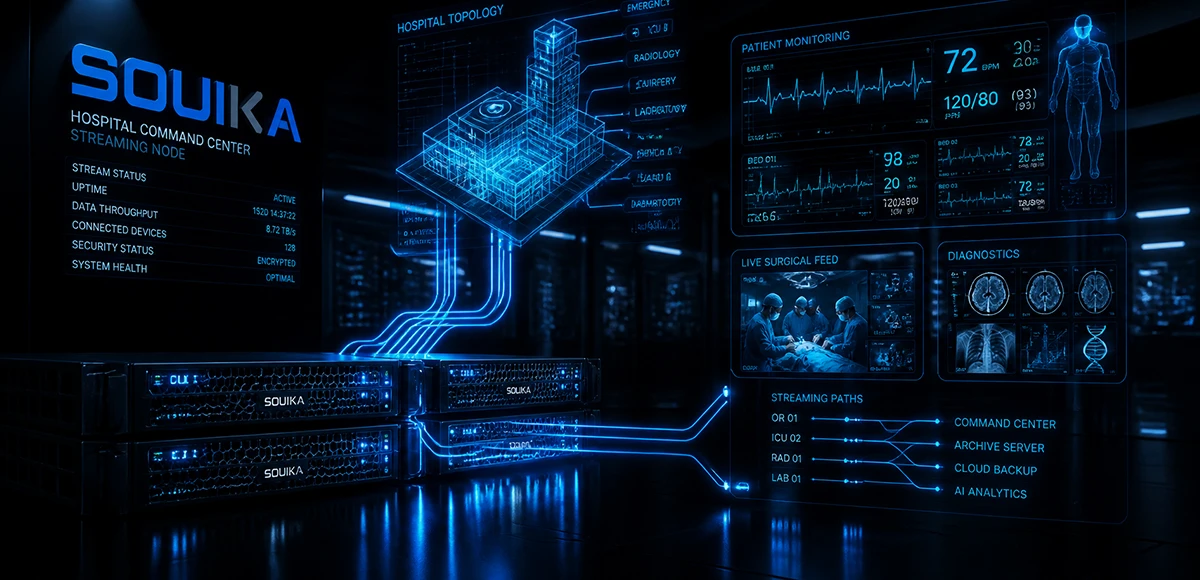
IPTV Solution for Hospital
Deliver zero-downtime 4K live broadcast, interactive patient education channels, and doctor-patient service portals across wards and consultation rooms. Powered by SOUKA’s high-concurrency streaming core, our carrier-grade system natively bridges with Hospital Information Systems (HIS) while strictly isolating video multicast traffic from sensitive medical telemetry networks.
Explore Solutions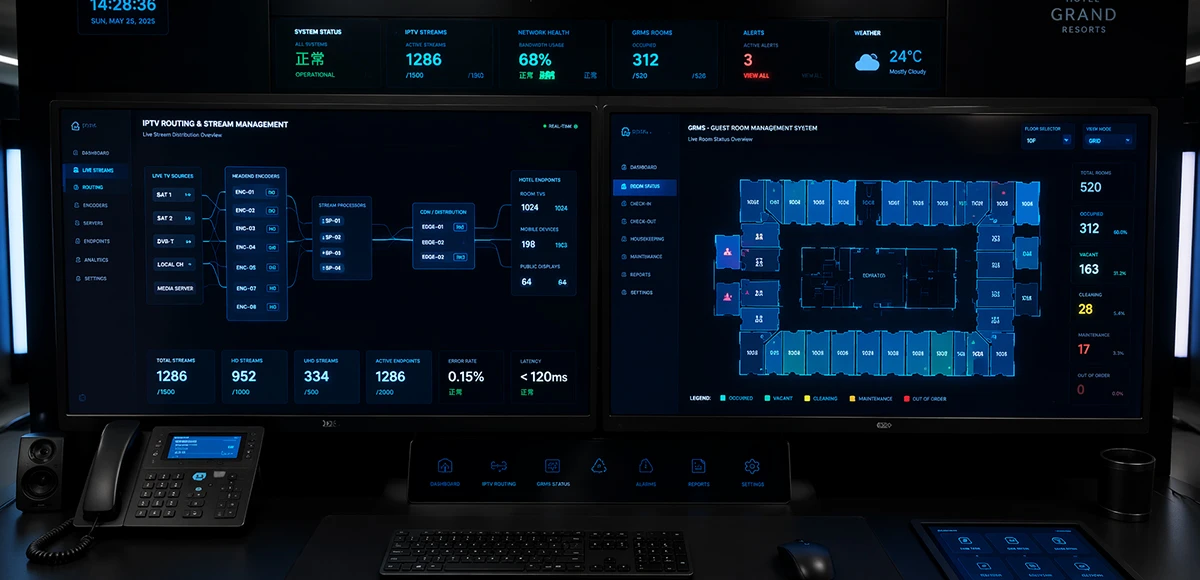
Integrated IPTV & GRMS Solution
Unify carrier-grade 4K IPTV streaming and autonomous RCU room controls into a single, cohesive hospitality IoT architecture. SOUKA bridges interactive in-room entertainment, smart lighting scenes, dynamic HVAC energy optimization, and native PMS database synchronization—slashing hardware CapEx, simplifying structured cabling, and delivering seamless guest experiences.
Explore Solutions
IPTV Solution for Hotels
Deliver lag-free 4K live TV to every guest room, customize your interactive brand interface with zero coding, and automate database workflows. Our carrier-grade Linux streaming matrix bridges natively with global property management systems to eliminate integration friction and slash hardware deployment overhead.
Explore Solutions
IPTV Solution for Hospital
Deliver zero-downtime 4K live broadcast, interactive patient education channels, and doctor-patient service portals across wards and consultation rooms. Powered by SOUKA’s high-concurrency streaming core, our carrier-grade system natively bridges with Hospital Information Systems (HIS) while strictly isolating video multicast traffic from sensitive medical telemetry networks.
Explore Solutions
Integrated IPTV & GRMS Solution
Unify carrier-grade 4K IPTV streaming and autonomous RCU room controls into a single, cohesive hospitality IoT architecture. SOUKA bridges interactive in-room entertainment, smart lighting scenes, dynamic HVAC energy optimization, and native PMS database synchronization—slashing hardware CapEx, simplifying structured cabling, and delivering seamless guest experiences.
Explore SolutionsFrequently Asked Questions
Conclusion
Select a multi channel IPTV encoder by its accepted simultaneous workload, the services affected by shared failures and the cost of operating and restoring the complete configuration. Higher density can be valuable when rack space and management effort are constrained; smaller groups can be useful when channel isolation and replacement flexibility matter. Test the proposed arrangement rather than assuming either outcome.
Prepare the source inventory, output-profile matrix, receiver list and recovery requirements before requesting prices. Ask SOUKA to review your encoder density and spare plan so the quotation can identify suitable models, required accessories and any items still needing a pilot. Keep the agreed configuration and recovery record with the installation documents for future expansion and maintenance.