A QAM modulator can carry centrally managed television services across an existing hotel coax network, but the modulation label alone is not a purchasing specification. A device may accept the required streams yet generate a cable format that the installed televisions cannot receive. Another may have enough RF carriers while lacking the processing capacity needed for the proposed programme lineup.
This guide helps hotel engineers, system integrators and B2B buyers turn those uncertainties into a model-specific request for quotation. It covers receiver compatibility, input formats, constellation choices, usable capacity, RF output and management requirements. Use SOUKA's digital TV modulator range as the commercial starting point, then agree the exact configuration and a representative acceptance test before approving equipment.
Start with the receiving televisions and the cable standard
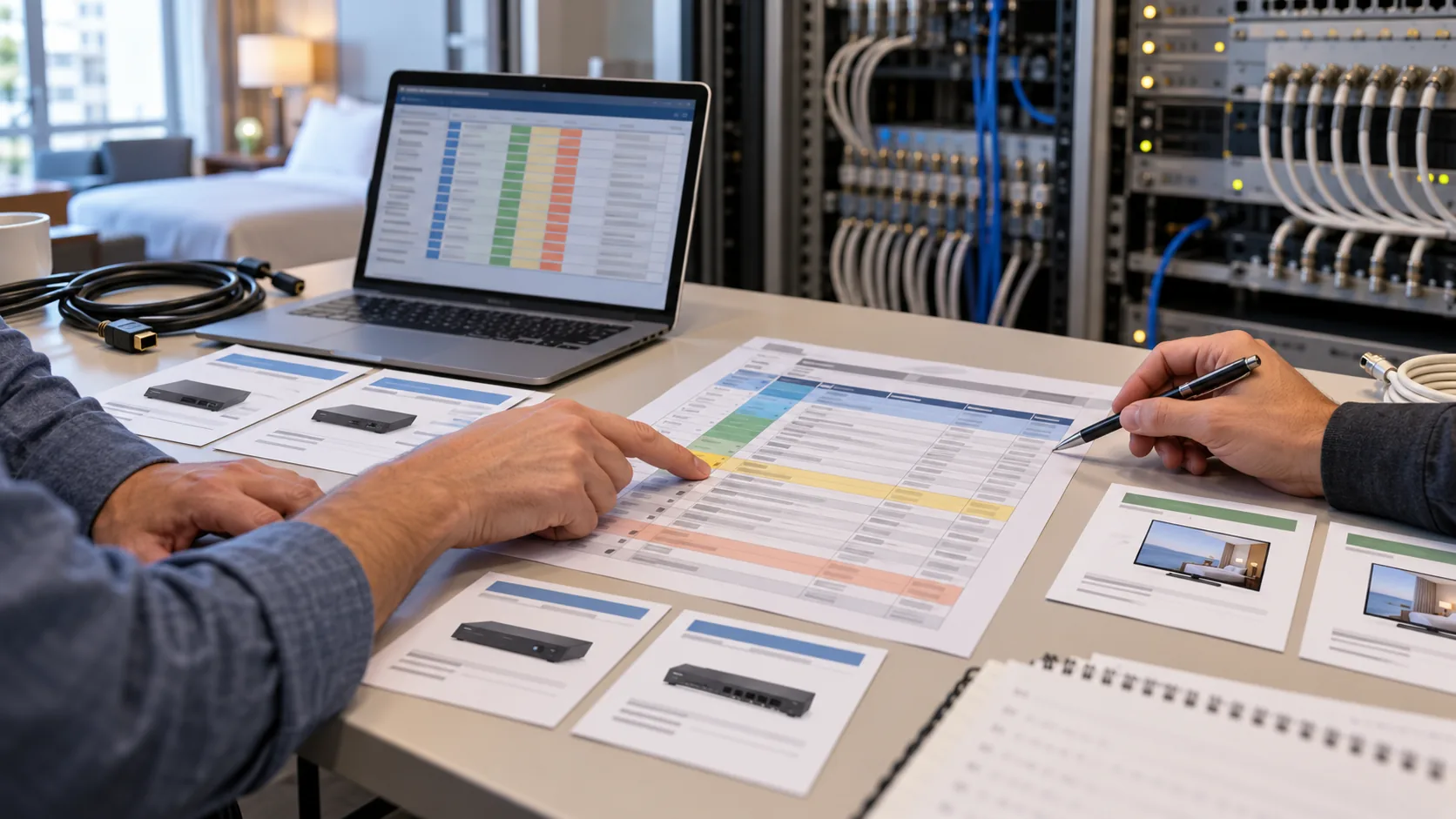
Begin with a receiver inventory, not a room total. Record each television or set-top-box model, regional variant, firmware version and intended tuning mode. Group rooms by receiver family and include retained screens in phased renovations. A demonstration on one new television establishes compatibility with that sample, not with the whole property.
QAM describes quadrature amplitude modulation. It does not identify every part of the cable transmission system. ITU-T J.83 specifies several cable systems through separate annexes. Annex A and Annex B use different transmission arrangements; selecting the same constellation does not make them interchangeable. Put the annex, channel bandwidth and supported symbol-rate settings into the quotation.
Confirm tuning, decoding and service discovery separately
A receiver must lock to the RF signal, identify its services and decode their video and audio. Those are separate requirements. A screen can receive a carrier while showing a black picture because the codec, profile, resolution or audio format is unsupported. Scan mode and service signalling can also affect whether programmes appear correctly in the channel list.
Ask the installer to test those stages with the proposed source material. Include cold starts, retuning, channel changes and the hotel's actual operating mode. Record any receiver settings required for reliable operation so that housekeeping or a factory reset does not silently change the accepted configuration.
The ATSC hotel television compatibility guide provides context when a project is comparing terrestrial ATSC reception with cable QAM. Keep the two reception paths explicit. Request the exact output standard supported by the ordered hardware and firmware, rather than treating a multi-standard family name as proof that every mode is enabled.
Choose the input path: HDMI encoding or IP-to-QAM
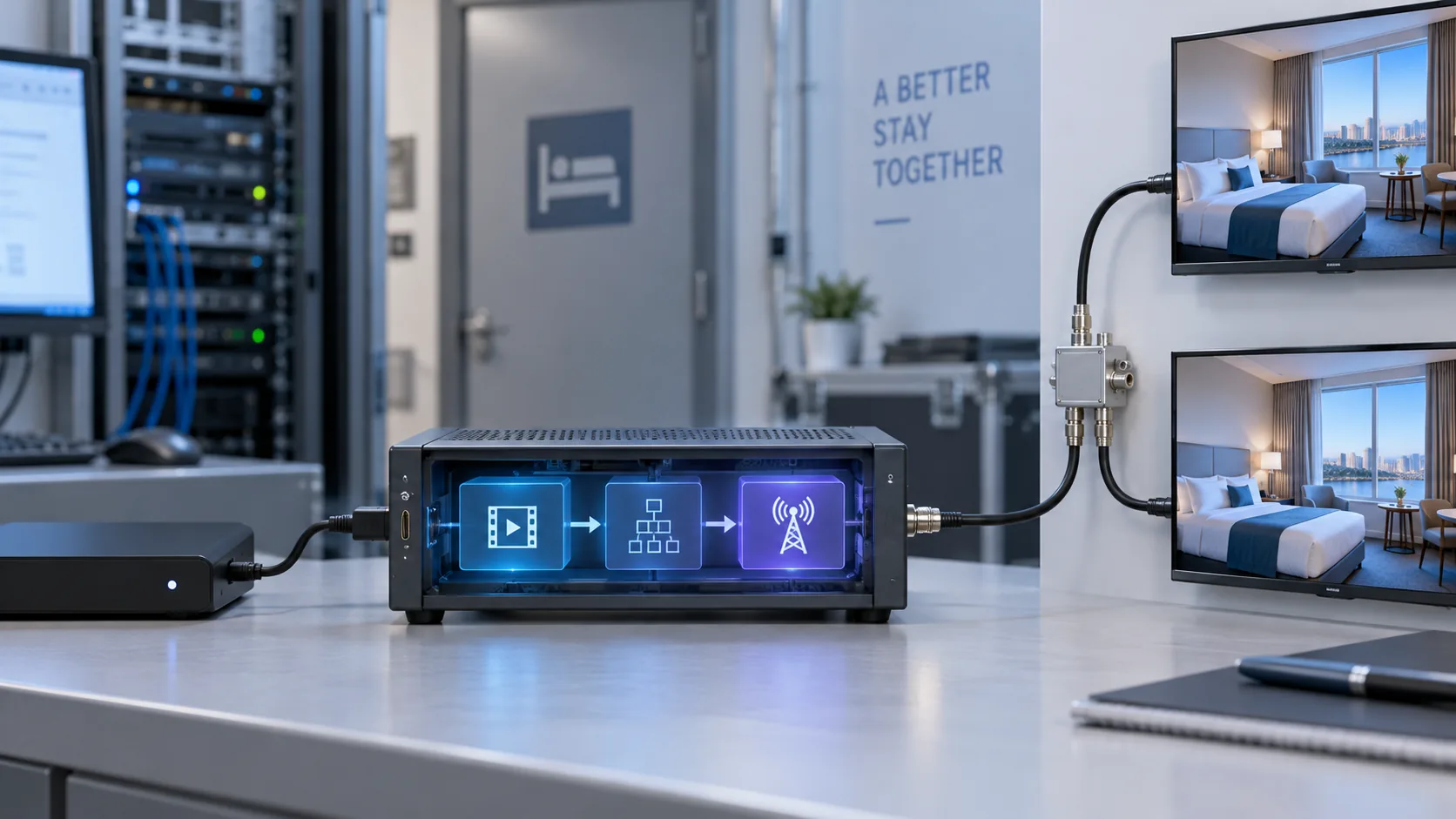
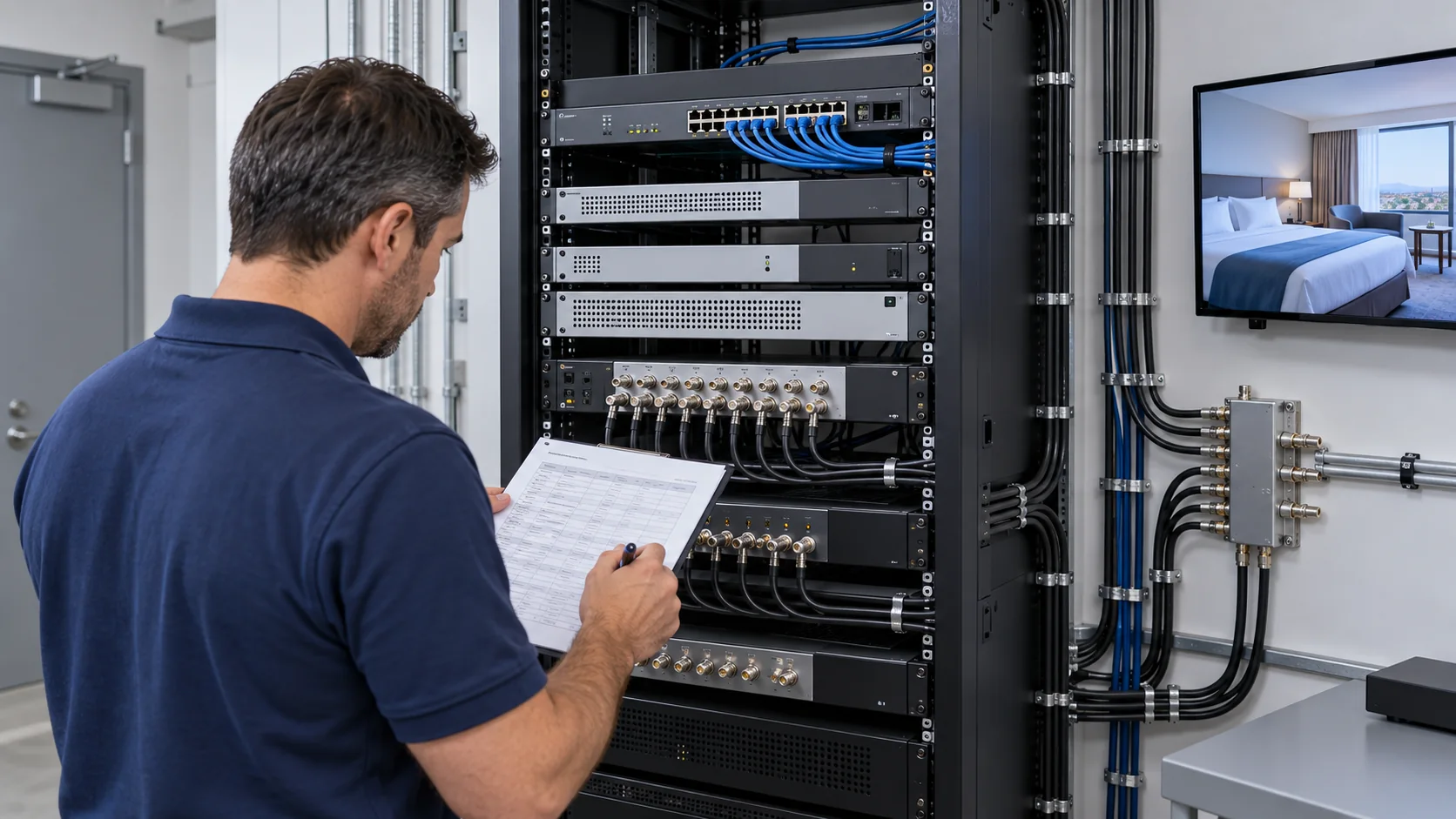
An HDMI to QAM modulator starts with an audio/video signal that must be encoded before cable modulation. An IP to QAM modulator usually starts with an already encoded transport stream. The second function does not automatically include HDMI capture or video transcoding. Establish where each processing step occurs and who supplies it.
For HDMI sources, specify simultaneous input count, accepted timings, video encoding, audio handling and source-protection requirements. Confirm that the content owner permits the intended redistribution. Signal conversion does not grant commercial distribution rights or establish that protected HDMI content can be accepted.
Describe the IP stream beyond the network connector
A Gigabit Ethernet socket does not prove support for every stream or application protocol. Identify unicast or multicast delivery, UDP or RTP transport, single-programme or multi-programme transport streams, destination addresses, ports and any relevant source-selection rules. Where a camera, streaming server or remote feed is involved, supply a representative stream for validation.
Do not assume an edge QAM modulator will open an HLS playlist, an RTSP camera URL or an SRT contribution feed unless the exact model explicitly supports that protocol and operating combination. Also confirm whether it passes the encoded stream through, remultiplexes services or actually transcodes video. Each capability has different resource and compatibility implications.
For mixed HDMI and IP projects, document the proposed signal path source by source. The hotel RF signal-flow guide explains the boundaries between encoding, multiplexing, RF distribution and reception. Use those boundaries to identify missing equipment before comparing chassis prices.
During network testing, check simultaneous stream delivery, multicast forwarding and recovery after a source or switch restart. A stream visible on a laptop is useful evidence, but it does not establish that the modulator can ingest and remultiplex the complete lineup.
Compare 64-QAM and 256-QAM using measured margin
At the same symbol rate, 64-QAM represents six bits per symbol and 256-QAM represents eight. That makes 256-QAM a way to carry more gross information without simply multiplying the number of RF carriers. However, the points are more closely spaced in the constellation, so reception requires better signal quality under comparable conditions.
The purchasing decision should connect capacity with the quality available at the receivers. Do not select a higher constellation only because the headend specification lists it. Inspect the installed cable plant, connectors, amplifiers, splitters and outlets, then measure the intended carriers at representative locations.
Use MER and error measurements with RF level
RF level alone cannot demonstrate a clean digital signal. Ask for modulation error ratio, relevant pre- and post-error-correction measurements, and a check for intermittent failures using a meter configured for the actual system. Define the measurement point, instrument settings and agreed acceptance criteria with the integrator.
A good measurement directly at the modulator is the baseline. Room measurements reveal what the distribution network adds. Include near and remote outlets, difficult branches and frequencies spanning the intended lineup. Evaluate all planned carriers together because the complete signal loading can expose amplifier or combining limitations.
A lower constellation may be worth evaluating where receiver support and capacity allow it, but it is not a substitute for correcting damaged cable or an overloaded amplifier. If the proposed change reduces usable capacity, recalculate the programme allocation. Keep a record of both picture quality and transmission margin instead of approving a change that fixes one channel while crowding another carrier.
For the wider purchasing test sequence, use the professional HDMI modulator comparison and pilot guide. Keep the signed test configuration attached to the quotation so that factory and installation checks evaluate the same operating mode.
Budget programmes, carriers and usable transport capacity
Keep four quantities separate: available input services, simultaneously processed services, RF carriers and usable transport capacity per carrier. A quotation for a multi-channel QAM RF modulator should define each quantity. It should also explain whether modes share processing resources or require additional licenses or modules.
For a conceptual gross-rate calculation, multiply symbol rate by bits per symbol. At an assumed 6.9 million symbols per second, 64-QAM represents 41.4 Mbit/s and 256-QAM represents 55.2 Mbit/s before coding and transport-related allowances. These are illustrative gross rates, not usable programme capacities or guaranteed settings for a particular product.
Ask for the usable capacity of the ordered mode
The actual payload available depends on the transmission system and configuration. Obtain it from the supplier for the specific annex, constellation and symbol rate. Subtract or budget the applicable signalling, transport requirements and operating headroom without counting an allowance twice. For variable-rate sources, agree how aggregate peaks are bounded.
For an independent planning example, suppose the supplier confirms 40 Mbit/s of usable transport capacity for a chosen mode. Assume each service is budgeted at 5 Mbit/s including its allocated audio and transport contribution, with a separate 5 Mbit/s reserve. Seven services consume 40 Mbit/s in that worksheet; eight would require 45 Mbit/s. These assumed figures explain the method and are not a product recommendation.
Check the device's total input rate, per-port rate, remultiplexing limits and output allocation as well. Several spare carriers do not resolve a shared input bottleneck. Include every simultaneous service in a sustained test using representative motion and audio, rather than judging capacity from a static welcome screen.
The hotel TV channel-planning checklist covers the service records used to turn this budget into a deployable lineup. Keep the budget and the channel plan under the same revision number.
Specify RF output and the existing coax distribution path
List the required carrier frequencies, bandwidths and output arrangement. Check whether the proposed device provides adjacent or independently placed carriers, separate RF ports or an internally combined output. Confirm what the advertised carrier count means for the exact module population and enabled standard.
Request output level specifications with units and conditions. A per-carrier value and a combined-output value describe different measurements. Record whether a figure applies to one module, one connector or a fully populated unit. Compare like with like and obtain the adjustment range needed for the installed network.
Plan combining and amplification for the complete lineup
Review cable routes, component bandwidth, insertion losses and existing services before choosing frequencies. The final design must account for the whole lineup, not just one new carrier at an otherwise empty output. More output power does not repair poor signal quality and can overload downstream equipment.
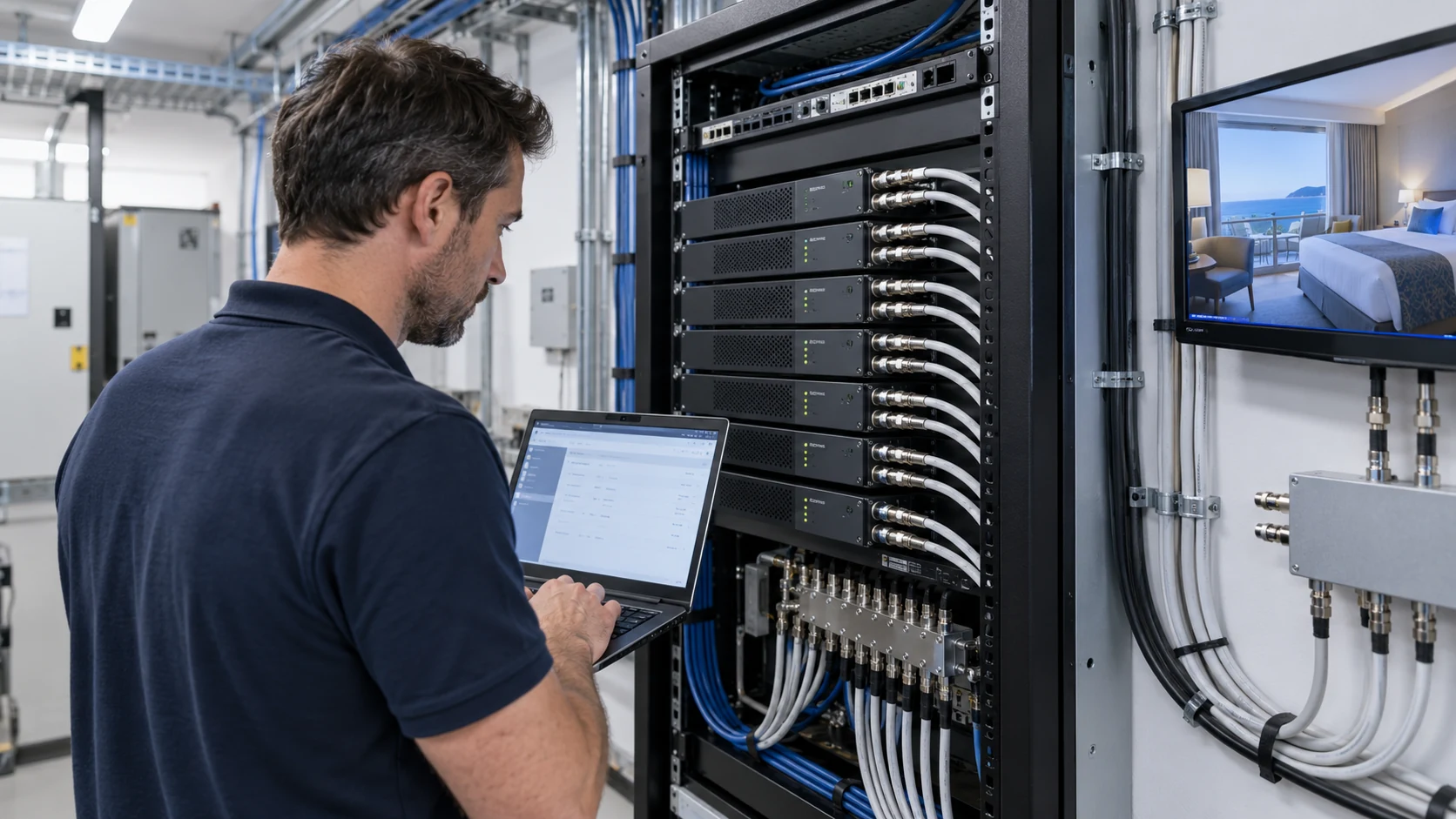
Have the installer document levels and quality at the headend and representative outlets. Include the lowest and highest intended carrier frequencies where practical. If a receiver works close to the rack but fails on one branch, retain the baseline and investigate the distribution path before changing encoding settings.
Keep the private television distribution boundary clear. A QAM modulator used for an internal hotel network is not a cable modem or an internet access service. Where provider services, shared coax or other building systems are present, require an approved integration design and appropriate isolation.
SOUKA's Cable TV Solution for Hotels is the relevant starting point for a project review covering reception, modulation, combining and room distribution. Supply the current network drawing and measurements so that the proposed equipment list reflects installation work as well as headend hardware.
Make monitoring and recovery part of the quotation
The buying decision continues after a programme first appears on screen. Specify how the hotel team will identify source loss, input-stream problems, RF-output faults and changes in the operating configuration. Ask which alarms are actually available on the ordered device and how operators receive or inspect them.
Separate documented features from requested features. A web interface may support configuration without providing a historical alarm log, SNMP integration or automatic failover. If one of those functions matters to the project, ask the supplier to demonstrate it and record any license, external system or firmware dependency.
Define the recovery procedure that staff can repeat
Request a configuration export, a saved accepted baseline, firmware identification and clear instructions for replacing a failed unit or module. Confirm whether a replacement can inherit settings and what manual steps remain. A hot-swappable module can shorten maintenance work, but it does not by itself establish uninterrupted programmes or a redundant signal path.
Choose access arrangements that fit the property's IT policy. Limit management access to authorized staff, change default credentials through the approved process and avoid exposing the management interface directly to the internet. Record the responsible service contact and how configuration changes are approved.
Include power interruption and restart tests in the pilot. Check whether sources resume, services keep their identities and the receivers return to a usable state. Describe the expected behaviour during loss and restoration of an IP feed instead of relying on the phrase automatic recovery.
For phased expansion, ask about spare module slots, available carrier capacity, cooling and replacement availability. The single-channel versus multi-channel headend guide explains maintenance tradeoffs. Use that context to compare the operational consequences of one shared chassis against several smaller units.
Use a request-for-quotation matrix that exposes gaps
A useful RFQ lets suppliers answer the same questions and identify unresolved requirements. Give each field an owner and distinguish a documented capability from a pilot result. An unanswered field should remain open until it has evidence, rather than being interpreted as included in a general compliance statement.
| RFQ field | Information to provide or request | Evidence for acceptance |
|---|---|---|
| Receiver compatibility | TV models, firmware, annex, tuning and decoding formats | Representative receivers tune, decode and retain the lineup |
| Input path | HDMI sources or IP protocols, SPTS/MPTS and simultaneous rates | Actual sources operate together without input loss |
| Modulation and capacity | Constellation, symbol rate, usable capacity and allocation limits | Full-service budget and sustained workload test |
| RF distribution | Frequencies, ports, level conditions and coax drawing | Headend and room measurements against agreed criteria |
| Management and recovery | Required alarms, configuration backup and replacement steps | Demonstrated restart, source-loss and restore procedure |
| Commercial delivery | Exact model, populated modules, firmware, licenses and support | Quotation and factory record match the pilot configuration |
Compare the configured system cost
Compare the equipment that performs the complete job: encoders where required, input gateways, modulator modules, combining hardware, commissioning work and any necessary receivers. Include spare parts, training and support responsibilities. A lower chassis price can lose its advantage if the proposal omits an essential processing stage.
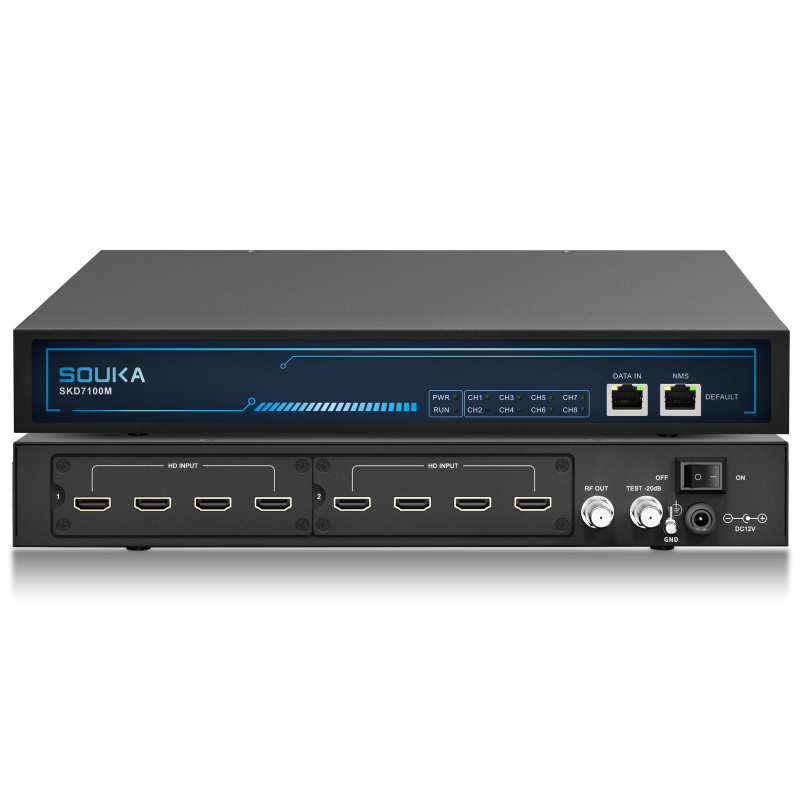
For SOUKA model discussions, the IP Input Edge QAM modulator provides a starting point for IP-to-cable projects. Its published information should be checked against the required annex, stream type, populated modules and enabled output combination. Do not extend one model's specifications to the rest of the range.
Submit sample streams and receiver details with the RFQ. Ask SOUKA to return a configuration-specific response and identify every item still needing confirmation. That makes supplier comparison and later factory acceptance much easier to trace.
Approve a pilot before committing the whole property
Build a controlled test with the proposed hardware, firmware and source formats. Include the oldest retained receiver family as well as the newest. Use a known-good short RF connection to establish a baseline, then repeat the checks through representative hotel distribution paths.
Confirm service discovery, picture, audio, subtitles where required, channel changes and startup behaviour. Run the intended lineup simultaneously and use material representative of actual operation. Document the test duration and conditions agreed for the project instead of claiming that a brief demonstration establishes long-term reliability.
Keep evidence and a reversible cutover
Save the accepted configuration, channel plan, measurement records and unresolved items. Identify which rooms and services are included in the pilot and who can approve expansion. For a live hotel, arrange an appropriate maintenance window and preserve the previous working setup until the new service passes the agreed checks.
A rollback instruction should name the connections and configuration needed to return to that setup. Assign responsibility for making the decision and communicating it to hotel operations. Test the proposed recovery steps where practical, especially when new sources share existing combining or amplification equipment.
If the project also needs interactive menus, guest messaging or software integrations, define those functions separately from RF television transport. The IPTV Solution for Hotels explains the alternative architecture to discuss when those services are required. A cable QAM signal alone does not provide an interactive IPTV platform.
The purchase approval should therefore refer to a specific configuration and its pilot evidence. Keep any untested receiver, unsupported protocol or unresolved operational requirement visible in the acceptance record and agree its resolution before the full rollout.
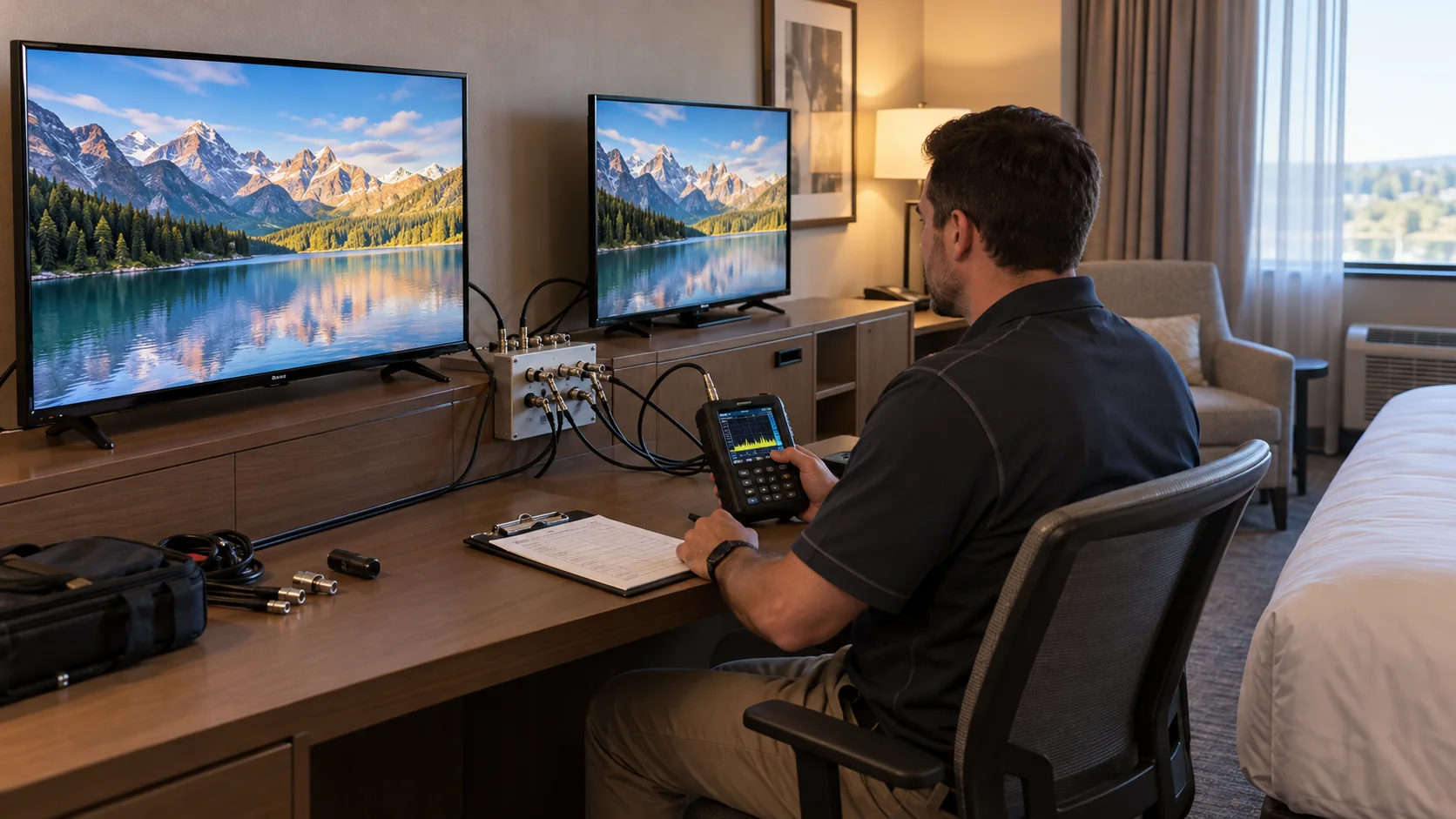
Related Products
Related Solutions
Cable TV Solution for Hotels
Deliver stable live television to every guest room without rebuilding the property network. SOUKA combines multi-source reception, high-density digital or analog modulation, RF combining, amplification, and centralized headend management for new hotels, phased renovations, and legacy coax upgrades.
Explore Solutions
IPTV Solution for Hotels
Deliver lag-free 4K live TV to every guest room, customize your interactive brand interface with zero coding, and automate database workflows. Our carrier-grade Linux streaming matrix bridges natively with global property management systems to eliminate integration friction and slash hardware deployment overhead.
Explore Solutions
Cable TV Solution for Hotels
Deliver stable live television to every guest room without rebuilding the property network. SOUKA combines multi-source reception, high-density digital or analog modulation, RF combining, amplification, and centralized headend management for new hotels, phased renovations, and legacy coax upgrades.
Explore Solutions
IPTV Solution for Hotels
Deliver lag-free 4K live TV to every guest room, customize your interactive brand interface with zero coding, and automate database workflows. Our carrier-grade Linux streaming matrix bridges natively with global property management systems to eliminate integration friction and slash hardware deployment overhead.
Explore SolutionsFrequently Asked Questions
Conclusion: buy the configuration the receivers can use
A suitable QAM modulator matches the receiving televisions, source formats, usable transport budget and installed coax network. Start with the cable standard and receiver tests, then compare input processing, constellation, RF output and recovery procedures. Approve the whole operating combination rather than a collection of isolated maximum specifications.
For hotel owners and integrators, the most useful purchasing document is a configuration-specific RFQ supported by a receiver matrix, source samples and a pilot record. Those documents give installation and operations teams a shared baseline for commissioning, maintenance and expansion.
Contact SOUKA for a QAM modulator configuration review with your TV models, required programme lineup, input streams and coax network drawing. Ask for confirmation of the annex, populated modules, simultaneous capacity and acceptance scope before ordering.
Technical references: the ITU-T J.83 cable transmission recommendation defines the separate cable systems. The Keysight DVB QAM measurement documentation describes measurement settings for DVB QAM signals. Project acceptance limits remain specific to the agreed system and receiver requirements.